


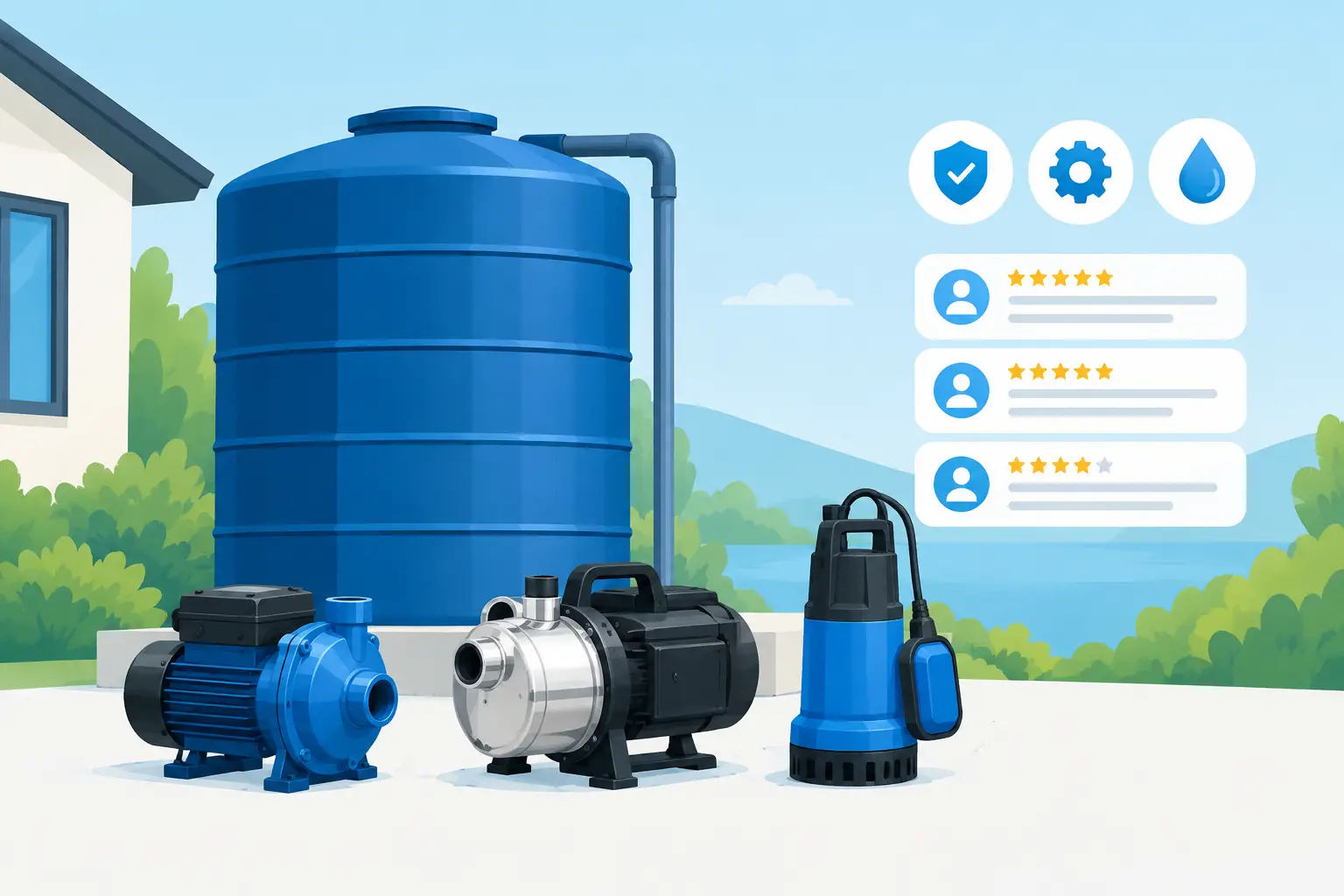
A pump can look excellent on paper and still be wrong for the job. Many water tank pump reviews focus on whether a unit arrived quickly or ran quietly on day one, but the details that matter are whether it supplies enough pressure at the tap, handles the required distance and height, and keeps working through a long dry spell. For a household, farm, acreage or small business, choosing a pump is about matching it to the complete water system.
How to Read Water Tank Pump Reviews Properly
A review is most useful when the reviewer has a setup similar to yours. A pump feeding one garden tap beside a tank has a very different workload from a pressure pump supplying a two-storey home, an irrigation system, livestock troughs and a shed.
Look beyond a star rating and find out what the pump is being asked to do. Useful reviews normally mention the size of the tank, number of outlets, pipe diameter, lift from tank to house, distance to the furthest tap and whether the water is used for domestic supply, irrigation or both. Without this context, statements such as “great pressure” or “not powerful enough” do not tell the full story.
It is also worth checking how long the unit has been in service. A review written after installation can help identify delivery or fitting issues. A review after six or 12 months is more valuable for judging reliability, controller performance and whether the pump maintains consistent pressure.
The Specifications Behind Good Pump Reviews
Pressure is not the same as flow
Pressure is what gives a shower, washing machine or hose usable force. Flow is the volume of water delivered, usually shown in litres per minute. A pump can have high maximum pressure but still struggle if several fixtures are running at once and its available flow falls short.
For a rainwater-fed house, consider realistic peak demand. If someone is showering while the washing machine fills and another tap is opened, the pump must provide enough flow without cycling excessively or producing a weak, uneven supply. For irrigation, the required flow rate and operating pressure should be based on the number and type of sprinklers or drippers running at one time.
Head height and pipe run change the result
Pump performance figures are measured under specific conditions. The further water travels, the higher it must be lifted and the narrower the pipework, the more performance is lost through friction and head pressure.
This is why a pump that performs well beside a tank may disappoint when the house is uphill or several hundred metres away. Check the pump curve rather than relying only on a maximum pressure or maximum flow claim. The useful figure is the flow the pump can supply at your actual operating pressure and total head.
Automatic controls need to suit the application
Most household tank pumps use an automatic pressure controller, pressure switch, or variable-speed controller to start the pump when water is drawn. Reviews that mention repeated starting and stopping, delayed restart or nuisance fault alarms should be taken seriously, as controls are a common source of frustration when they are poorly matched or incorrectly installed.
A standard on-off pressure pump is often a practical, cost-effective choice for a straightforward house supply. Variable-speed pumps can provide more even pressure and may reduce cycling in some applications, but they cost more and should be selected with the plumbing layout and demand profile in mind. More electronics do not automatically make a pump better for every property.
Materials and water quality affect service life
For clean rainwater, a quality domestic pressure pump with suitable seals, corrosion-resistant components and thermal protection is generally appropriate. Water containing sediment, fine sand, algae or debris requires attention before it reaches the pump.
A leaf strainer, first-flush device, inlet screen and correctly sized sediment filtration can protect both the pump and household fixtures. If reviews describe seal wear, blocked controllers or poor performance, the underlying issue may be tank sediment or inadequate pre-filtration rather than the pump itself. A pump should not be expected to compensate for neglected tank hygiene.
Match the Pump to the Job, Not the Biggest Number
The largest pump is rarely the smartest purchase. An oversized unit can cycle more aggressively on low-flow demand, use more power and place unnecessary strain on pipework and fittings. A pump that is too small will struggle during busy periods and may run for long periods trying to meet demand.
For a typical home supplied from a rainwater tank, the starting point is the number of bathrooms, appliances and outdoor taps likely to operate together. For a rural property, allow for house demand separately from stock water or irrigation where possible. Separating these jobs can make the system easier to manage and avoids a domestic pressure pump being pushed beyond its intended role.
Garden and irrigation systems need a different calculation. Sprinklers require a certain operating pressure to throw water evenly, while long poly lines and elevation changes reduce pressure at the outlet. Bore, dam and transfer applications may call for a multistage centrifugal pump, submersible pump or higher-head model rather than a standard household pressure pump.
If the pump supports drinking water supply, use components suitable for potable water applications and ensure the overall system meets relevant Australian requirements. The pump is only one part of the result. Tank material, inlet protection, filtration, UV treatment where required, pipework and installation quality all matter.
Common Review Complaints and What They Usually Mean
“Pressure drops when two taps are open” usually points to insufficient pump flow for the demand, pipe friction losses, a blocked filter or a restriction in the plumbing. It is not always evidence of a faulty pump.
“The pump turns on and off constantly” can indicate a small leak, a faulty non-return valve, an unsuitable pressure setting, a blocked filter or an oversized pump on a low-demand system. Short cycling should be addressed promptly because it increases wear.
“It is noisy” needs context. All surface-mounted pumps make some sound, particularly when starting. Excessive vibration can result from a poor mounting surface, loose pipework, air entering the suction line or a pump working too hard. A solid base, flexible connectors where suitable and correct pipe support can make a noticeable difference.
“It stopped working after a power outage” may relate to dry-run protection or an electronic controller needing a reset. Dry-run protection is valuable where tanks can run low, but it needs to be correctly set up and easy for the owner to understand. A system that protects the motor but leaves you without water after every brief interruption is not convenient.
Questions to Ask Before You Buy
Before comparing models, have the practical details ready: tank location and water level, vertical lift, pipe length and diameter, number of outlets, likely simultaneous use, water source and whether you need domestic supply, irrigation, transfer or all three. Also consider access for servicing and whether a backup water source or changeover arrangement is required.
Ask for the expected flow at your required pressure, not simply the pump’s maximum figures. Confirm what controller is included, whether dry-run protection is fitted, what filtration should be installed ahead of the pump and what maintenance is expected. A clear warranty is valuable, but local parts availability and technical support are equally important when water supply cannot wait.
North Coast Water Tanks can help property owners assess the tank, pump, filtration and accessory requirements as one system, rather than selecting a pump in isolation. That approach is especially useful when replacing an ageing pump, adding rainwater to an existing home or planning a new rural water setup.
Installation and Maintenance Shape the Review You Will Write
Even a quality pump can earn a poor review if it is installed with undersized pipework, an air leak on the suction side or no protection from weather and debris. Follow the manufacturer’s installation requirements, use an appropriate pump cover where needed and make sure the pump is accessible for inspection.
Check strainers and filters regularly, especially after heavy rain or strong winds. Keep the tank inlet system clean, inspect for leaks and listen for unusual cycling or vibration. If household pressure changes suddenly, investigate early rather than waiting for complete failure.
The best pump is the one that meets your actual demand quietly, efficiently and consistently, with support available when conditions change. Start with the water system you have, or the one you intend to build, and the right choice becomes much clearer.