



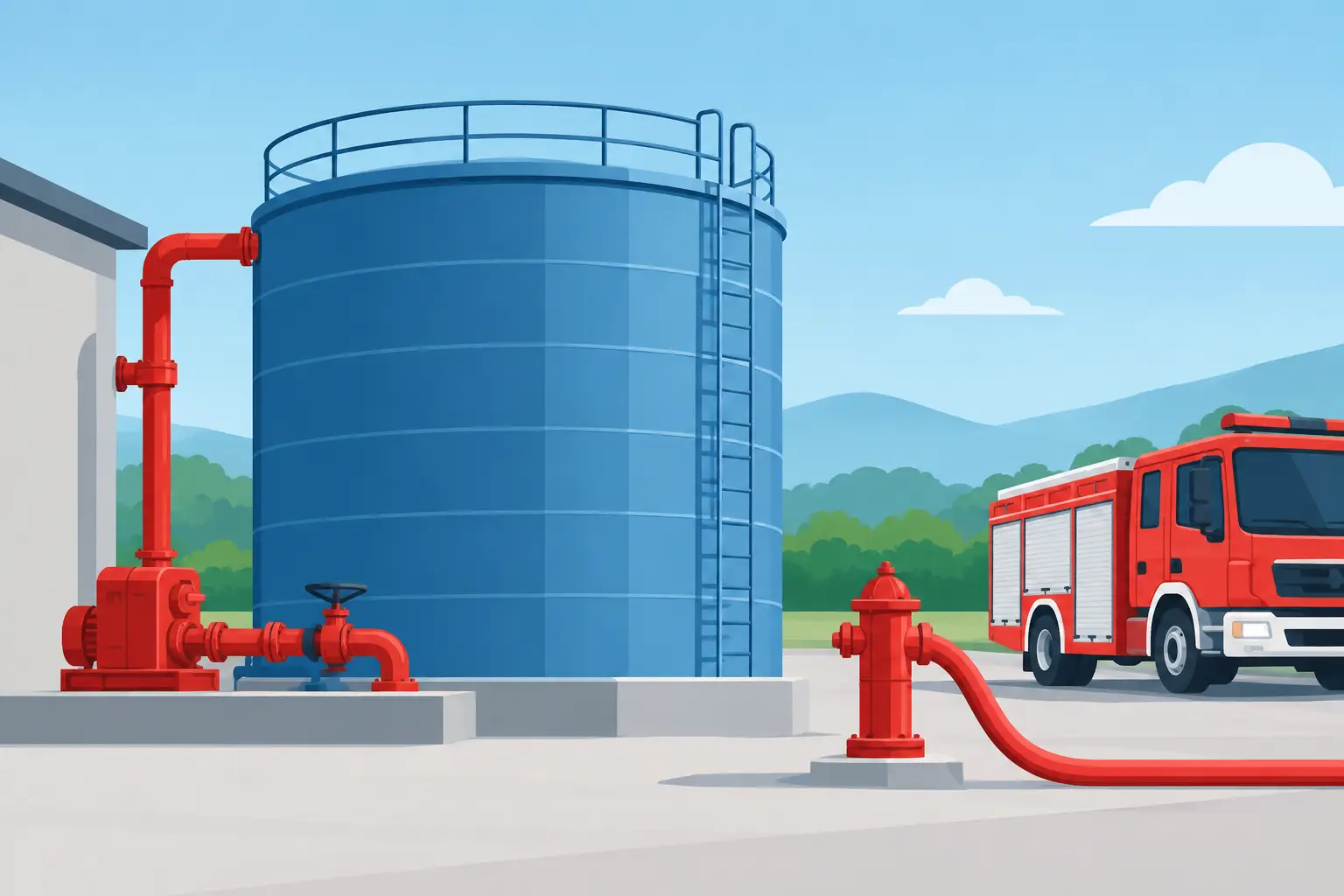
A water tank that keeps a home supplied through summer is not automatically ready to support firefighting. During a bushfire, a pump may need to deliver high flow at the same time the household supply is under pressure, power may be out, and crews may need clear access to a dedicated connection. Fire water storage needs to be planned as a working part of your property’s protection measures, not treated as spare water at the bottom of an existing tank.
For rural homes, farms, acreage blocks and small commercial sites, the right system depends on the property’s fire risk, its water demand, local requirements and the practical ability to get a truck, hose or pump to the tank. Good planning protects your stored supply and makes it easier to use when conditions are difficult.
What fire water storage needs to do
Fire water storage is a dedicated volume of water held for firefighting or property protection. It may supply a fire pump, sprinklers, hoses, a static water supply connection for fire crews, or a combination of these. The key word is dedicated. If a tank’s entire volume is available for household use, irrigation or stock, there is no certainty that the required water will still be there on a high-risk day.
A well-designed system considers four things together: storage volume, available flow, pump performance and access. A large tank with an undersized pump will not produce the pressure or delivery rate required by hoses or sprinkler lines. A capable pump is of limited use if the outlet is hard to find, inaccessible to a fire truck or blocked by overgrown vegetation. Each component has to suit the whole system.
On many properties, fire water is kept in a separate tank. On others, it is retained as a protected reserve within a larger domestic or rural supply tank. Both approaches can work, provided the reserve cannot be drawn down by normal water use and the outlet arrangement allows the available water to be accessed reliably.
Start with requirements, not tank size
There is no single tank capacity that suits every Australian property. Planning controls, building approvals, insurance conditions and local fire authority guidance can all affect what is required. This is particularly relevant in bushfire-prone areas where a Bushfire Attack Level assessment, planning permit or development approval may nominate a minimum firefighting water supply.
Before selecting a tank, confirm whether your requirement is for property protection, a fire service connection, a commercial fire system or a condition of approval. These uses are not interchangeable. A volume intended for a domestic bushfire hose setup may not meet the connection, access or signage requirements expected for attending fire crews.
Your local Rural Fire Service, Country Fire Authority, fire authority, council or certifier can clarify the relevant expectations for the site. Requirements can differ between states and regions, so avoid relying on a tank layout copied from another property. Your insurer may also have conditions worth checking, particularly where the tank supports a home in a bushfire-prone location.
Allow for retained volume
If water is shared between household use and firefighting, establish a level below which normal supply cannot draw. This can be managed with separate outlets positioned at different heights, a dedicated suction line, or controls that isolate the firefighting reserve. The best option depends on tank design, pump layout and how water is used across the property.
A visible water level indicator is useful, but it does not replace a protected reserve. During extended dry weather, an unprotected tank can fall below the intended firefighting volume without anyone noticing until it is needed.
Choosing the right tank for the site
Poly water tanks are a practical choice for many residential and rural properties. They are corrosion-resistant, available in a broad range of capacities and straightforward to position where vehicle access allows. For exposed sites, choose a quality tank suited to Australian conditions and install it on a properly prepared, level base that fully supports the tank floor.
Steel and Aquaplate tanks can be well suited to larger storage requirements or sites where a particular footprint and capacity are needed. Tank liners, roof structures and fittings should be selected for the intended water source and operating conditions. Whether the tank is poly or steel, the installation needs to accommodate full water weight, drainage around the base, safe access for maintenance and sufficient clearance for fittings.
Tank location is a practical decision, not just a matter of finding spare ground. Positioning the tank close to the dwelling can reduce pipe runs for a private firefighting system, while a clearly accessible connection may be more useful for emergency services. Consider driveway width, turning space, all-weather access, slope and whether a fire appliance could approach without passing under low branches or powerlines.
Keep the area around the tank maintained. Long grass, stored materials, loose equipment and dense vegetation can slow access at the exact time every minute matters. Clearly mark the tank and any firefighting connection so visitors, contractors and emergency crews can identify it quickly.
Pumps, pipework and fittings matter just as much
A fire water tank is only as useful as the system that draws from it. Pump selection should be based on the required flow and pressure at the point of use, not simply the pump’s advertised maximum output. Pipe length, pipe diameter, elevation changes, bends, valves and hose runs all reduce available performance.
For a dedicated property protection setup, a suitable fire pump may need to supply external hoses, sprinklers or hydrant-style outlets. Petrol or diesel-powered pumps can provide an option when grid power is unavailable, while electric pumps may need backup power where continued operation during an outage is essential. The appropriate arrangement depends on the site and the approved system design.
Use fittings that match the requirement and are compatible with local fire service expectations. Fire brigade connections, camlocks, Storz fittings and threaded outlets are not universal substitutes for one another. Confirm the correct fitting type, outlet size and connection location before installation. A reducer added at the last minute can restrict flow and create confusion when fast connection is needed.
A screened suction point, appropriate foot valve or strainer and sound pipework help protect the pump from debris. For rainwater tanks, leaf guards, gutter protection and first-flush diversion can reduce sediment entering storage, but the system still needs periodic inspection. Sediment at the bottom of a tank can affect pumps and reduce usable capacity over time.
Protect the supply from everyday use and contamination
Rainwater is a valuable source for fire water storage, particularly on properties with large roof catchments. However, harvesting alone does not guarantee a full tank through dry periods. Review expected rainfall, roof area, household demand and any irrigation or stock use before depending on one tank for everything.
Where mains water, bore water or another source is available, a controlled top-up arrangement may help maintain the firefighting reserve. Any connection between supplies should be designed to prevent backflow and comply with plumbing requirements. This is work for a qualified installer, especially where potable water systems are involved.
If the tank also supplies a house, keep drinking water quality and firefighting function separate in the design process. Filtration, UV sterilisation and household pump equipment can improve domestic water quality, but they should not restrict a dedicated firefighting outlet. A properly planned system can serve both needs without compromising either one.
Maintenance turns stored water into usable protection
A fire water system should be checked before the fire season, then maintained throughout the year. Start by confirming the reserve volume is present and the tank is structurally sound. Check the lid, insect screen, overflow, inlet strainers, valves and pipework for damage or blockage.
Run the pump under load and inspect its priming, pressure and fuel or power supply. Hoses should be serviceable, accessible and long enough to reach the intended protection areas. Replace perished washers, cracked fittings and damaged hoses before summer rather than hoping they will hold under pressure.
Keep access tracks clear and ensure tank signage remains visible. If the system has not been inspected for several years, or the tank contains heavy sediment, professional tank cleaning and maintenance can restore reliable operation. North Coast Water Tanks can assist property owners in matching tanks, pumps, filtration and accessories to a practical water storage plan.
The best time to resolve a poor outlet location, an undersized pump or an unprotected water reserve is when the weather is calm. Set up your fire water storage around the risks and requirements of your own property, test it regularly, and you will have a far more dependable source of water when it counts.