


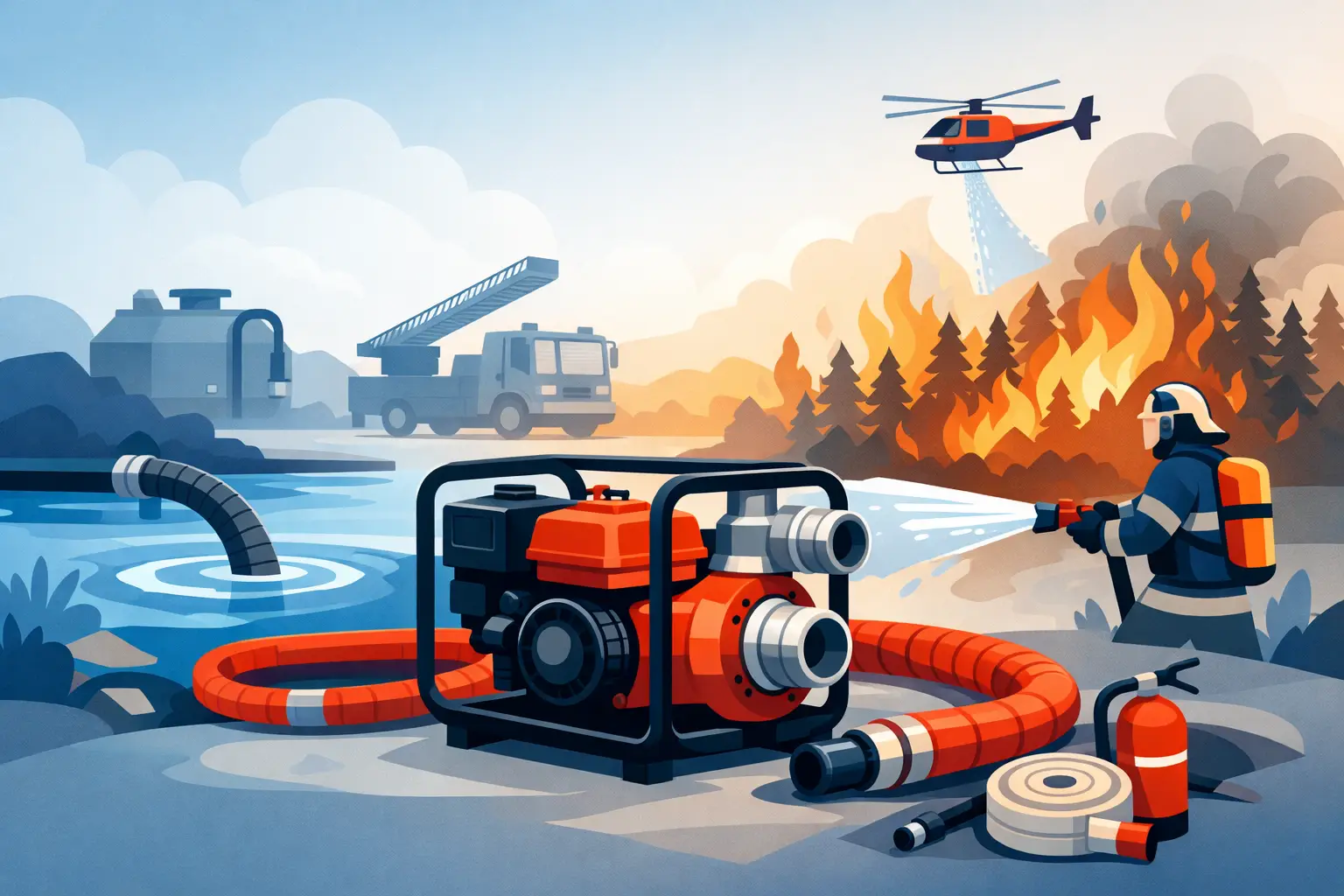
When a grass fire gets close, there is no time to wonder whether your firefighting water pump will prime properly, hold pressure, or pull enough water from the tank. For rural properties, acreage blocks, workshops and farm sheds, the right pump is not just another accessory. It is part of your emergency planning, and it needs to work the first time.
A firefighting setup has a simple job on paper – move water quickly and reliably where you need it. In practice, the right pump depends on your water source, the distance to the risk area, the hose size, the expected run time and how much manual handling you can realistically manage during an emergency. That is why choosing on price alone often leads to disappointment.
What a firefighting water pump needs to do
A standard transfer or garden pump is not always built for fire duty. A proper firefighting water pump is selected for high flow, dependable pressure and practical field use. That usually means a petrol or diesel-driven unit with enough output to supply fire hoses, sprinklers or protection lines around buildings and assets.
The key question is not just how much water the pump can move in ideal conditions. It is how it performs in your conditions. A pump drawing from a static water tank beside a shed will behave differently from one lifting out of a dam, creek or below-ground storage. Suction lift, hose length and fittings all affect real-world performance.
For most property owners, the aim is straightforward. You want enough flow to wet down vulnerable areas, defend access points and support hose use without the pressure dropping away as soon as the line opens up.
Tank, dam or creek – the water source matters
Your water source shapes the pump choice more than many people expect. If you are drawing from a rainwater tank, the setup is usually more predictable. The water is cleaner, suction lift may be lower and the installation can often be planned with a fixed line and fittings ready to go.
Drawing from a dam or creek can still work well, but it introduces more variables. You may deal with longer suction runs, algae, silt or debris, and seasonal water level changes. In that case, the pump needs to be matched with suitable strainers, hose quality and suction capability. Otherwise, the pump may struggle to prime or lose performance when you need it most.
If your property relies on stored water for household use as well as fire readiness, it also makes sense to think about available reserve. A pump can only deliver what the source can supply. A well-sized fire pump paired with inadequate storage is still a weak system.
Sizing a firefighting water pump properly
Pump sizing is where many buyers either overspend or underprepare. Bigger is not automatically better, but undersizing can leave you with poor pressure at the nozzle and limited reach.
Flow rate matters because it determines how much water you can actually put on a fire-prone area. Pressure matters because it affects how useable that water is through a hose line, branch or sprinkler. The balance between the two is what counts. A pump with strong advertised flow but weak practical pressure may look good in a product listing and disappoint in service.
You also need to account for friction losses. Every metre of hose, every bend, every reducer and every fitting creates resistance. If the pump is some distance from the protection zone, those losses add up quickly. This is especially relevant on larger rural blocks where the water source is not close to the house, machinery shed or boundary line.
As a rule, it helps to plan around the actual task. Are you trying to run one hose for spot protection, two hoses at once, roof-mounted sprinklers, or a combination of coverage points? The more demanding the job, the more careful the pump selection needs to be.
Petrol or diesel?
For many property owners, petrol-powered units are common because they are widely available, portable and relatively easy to start and maintain. They suit many residential and light rural applications where the pump may sit ready for emergency use but not run every day.
Diesel can be a better fit for heavier-duty applications, larger sites or operators who want fuel consistency with other farm equipment. Diesel units are often chosen where longer run times, durability and tougher service conditions are part of the picture.
The trade-off usually comes down to budget, weight, servicing preferences and how the pump will be stored and used. A portable petrol unit may be ideal for one owner and completely unsuitable for another if the site requires larger output or more sustained operation.
Portability versus fixed installation
Some customers want a pump they can keep on a trailer, in a shed or on the back of a ute, ready to deploy where needed. Others are better served by a fixed arrangement connected to dedicated fire water storage with clearly marked valves and hose points.
Portable systems offer flexibility, especially across larger properties. They can be moved between a house tank, dam point or outbuilding. The downside is that portable equipment still has to be positioned, connected and started under pressure. That is manageable if the operator is familiar with it, but it can become harder in smoke, heat and low visibility.
A fixed installation reduces setup time and can improve confidence. If the tank outlet, suction line, pump base and delivery points are already in place, there are fewer things to go wrong. This is often the better option where the goal is immediate use around a home, shed or commercial site.
Don’t overlook compatibility
A firefighting water pump is only one part of the system. Hose diameter, suction hose quality, nozzles, strainers, couplings and tank outlets all need to work together. Mismatched fittings are a common problem and one of the most frustrating, because the pump itself may be perfectly good.
This is where practical advice matters. It is not enough to buy a pump with a suitable engine and assume the rest will sort itself out later. The outlet size needs to suit your hose setup. The suction line must be reinforced and airtight. The tank connection should allow dependable flow without starving the pump.
On many properties, the fire pump also sits alongside broader water infrastructure such as rainwater tanks, transfer pumps, filtration equipment and general household supply. Thinking about the whole setup early usually saves money and avoids rushed modifications later.
Maintenance is part of readiness
Even a quality firefighting water pump can let you down if it sits neglected for years. Emergency equipment has to be kept in ready condition. That means regular test starts, fuel checks, oil changes, inspection of hoses and seals, and making sure fittings have not seized or degraded.
Water quality also plays a role. If the pump draws from open water, debris protection becomes critical. If it is connected to tank water, you still want to keep storage clean and outlets clear. A blocked suction strainer or perished hose can make the best pump feel useless.
A simple maintenance routine is often enough. Start the unit periodically, confirm it primes correctly, run water through the hose line and check pressure response. If something is off, it is far better to find out on a calm weekend than during fire season.
When to ask for advice
There are plenty of off-the-shelf pumps on the market, but not every property has an off-the-shelf requirement. If your block has elevation changes, multiple water sources, long hose runs or a need to protect more than one asset, tailored advice is worth having.
That is especially true if you are pairing a fire pump with new tank storage or upgrading an older property water system. In those cases, it often makes sense to choose the tank, outlets, accessories and pump as one coordinated setup rather than piecing it together over time. For customers who want practical support, a supplier such as North Coast Water Tanks can help match storage and pumping equipment to the site instead of leaving you to guess from product specs alone.
The right pump is the one that suits your property, your water source and the way you will actually use it. If you can start it quickly, trust its performance and know the system around it is fit for purpose, you are in a much stronger position when conditions turn bad.