


A tank can look like a straightforward purchase until it has to sit on a sloping block, pass through a narrow gate, supply a house through a dry spell, or fit into a working farm layout. When comparing steel versus poly water tanks, the right answer comes down to more than litres and price. Your site access, required capacity, water use, base preparation and local conditions all matter.
For many properties, both materials can provide dependable rainwater storage for years. The practical difference is how each tank gets to site, how it is supported, the capacities available and the maintenance it may require over its working life.
Steel versus poly: the main difference
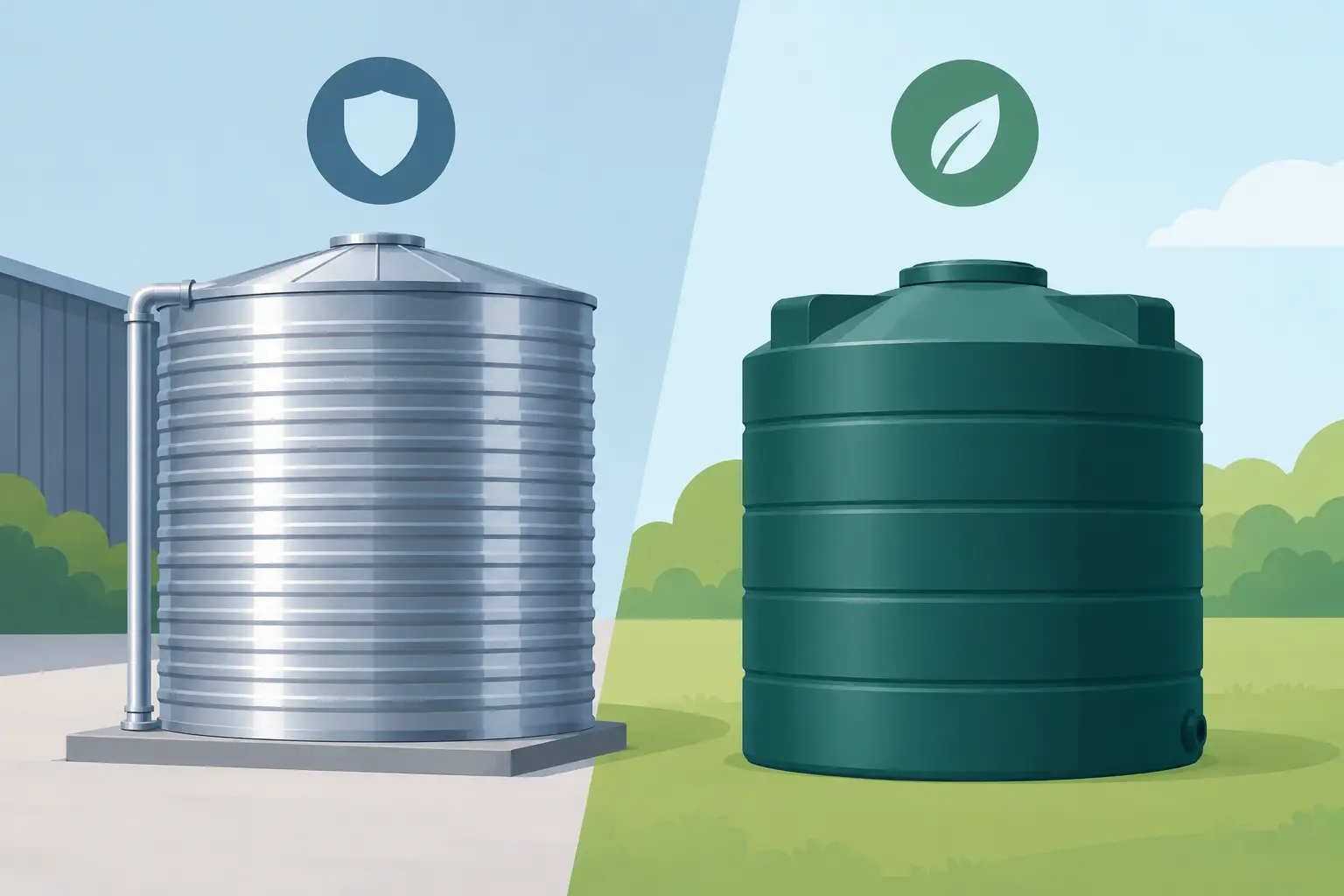
Poly water tanks are rotationally moulded from food-grade polyethylene. They are supplied as a single-piece tank, commonly in a wide range of colours and sizes, and are often a practical choice where access is limited or a tank needs to be positioned close to a home, shed or secondary dwelling.
Steel water tanks generally use corrugated steel walls with a fitted internal liner. Aquaplate tanks use steel sheeting designed specifically for water storage applications. Larger steel tanks may be delivered in components and assembled on site, which can make them suitable for substantial rural, agricultural and commercial storage where transporting one large tank is not possible.
Neither material is automatically better in every situation. A 22,500-litre household tank on an accessible block may suit poly very well. A large irrigation reserve behind a machinery shed may be better suited to a steel tank installed on site. Start with the water requirement, then assess the site.
When a poly water tank makes practical sense
Poly tanks are popular across residential and lifestyle properties for good reasons. Their one-piece construction means there are no wall panels or liner joins to install. Once a properly prepared base is ready, installation can be relatively efficient, subject to tank size and site access.
They are particularly useful for sites with tight spaces, established homes or difficult vehicle access. A tank may be able to be manoeuvred beside a house, through a wide side access, or placed where a larger steel build would be less convenient. Smaller poly tanks are also a sensible option for garden supply, toilet and laundry connections, small cabins, caravans and supplementary storage.
Poly tanks are available in a range of colours, allowing the tank to suit the house, shed or surrounding landscape. The material does not corrode, which is an advantage in coastal areas where salt-laden air can affect exposed metalwork over time.
That said, a poly tank still needs a sound base. Uneven support can cause stress in the tank floor and walls once it is full. The base must be level, compacted and adequately sized for the tank, with no rocks, sharp objects or unsupported edges. A tank that holds tens of thousands of litres is carrying a significant load, so base preparation is not a step to compromise on.
Poly can also have practical limits at very large capacities. Transporting a large one-piece tank requires suitable road access, turning space and a clear delivery path. Before ordering, check gates, overhead wires, trees, roof eaves, corners and the distance from the unloading point to the final tank location.
Where steel tanks are the stronger option
Steel tanks come into their own when capacity is the priority. Their modular or site-assembled design can allow very large volumes of water storage without the transport constraints of a single-piece tank. This makes steel a common choice for farms, irrigation, livestock water, commercial sites and properties building a serious rainwater reserve.
A steel tank can also be a practical answer where a delivery truck cannot bring a large complete tank into position. Components can be transported to site and assembled on a prepared pad. On a rural property with a long driveway, steep terrain or limited turning area, that flexibility can be valuable.
The appearance of corrugated steel also suits many farm and acreage settings. A steel tank can sit naturally beside a machinery shed, dairy, packing area or rural home while providing substantial storage capacity.
The trade-off is that a lined steel tank has more installation elements. The foundation, wall assembly, roof, liner, fittings and sealing all need to be handled correctly. A quality liner is central to the tank’s performance, and the finished installation should be protected from punctures, abrasive debris and poor site drainage. Choosing certified materials and experienced installation support helps avoid problems that can be costly once the tank is full.
Steel tanks also need sensible attention to the surrounding environment. Keep vegetation clear, direct roof overflow away from the base, and inspect external fittings and roof components as part of regular property maintenance. In coastal locations, product selection and ongoing care deserve particular consideration.
Capacity and water demand should lead the decision
It is easy to focus on tank material before calculating how much water the property actually needs. For a household relying on rainwater, capacity should account for the number of occupants, daily use, rainfall patterns, roof catchment area and the length of dry periods. Gardens, livestock, irrigation and fire-fighting reserves can increase the requirement quickly.
A smaller poly tank may be ideal for topping up garden water or reducing mains consumption. It may be inadequate for a family home that depends on rainwater year-round. Likewise, installing the biggest steel tank possible is not always the best investment if the roof catchment cannot refill it effectively.
Think about future use as well. A new shed roof, extra dwelling, expanding garden or small farming operation may change demand. Allowing capacity for a planned upgrade can be more cost-effective than replacing a tank too soon.
Installation conditions matter as much as the tank
Whether you choose steel or poly, the tank needs the right location. It should be close enough to the collection point and pump system to keep plumbing practical, while remaining accessible for cleaning, inspections and maintenance. Leave room around the tank for downpipes, valves, filters and safe access to fittings.
The ground needs to carry the full weight of stored water. As a guide, one litre of water weighs approximately one kilogram, before allowing for the tank itself. A 20,000-litre tank therefore represents more than 20 tonnes when full. A level, engineered concrete pad or correctly prepared compacted base is essential, depending on the tank type and manufacturer requirements.
Consider wind exposure, stormwater flow and site drainage. Water should not pool around the tank base. On exposed sites, anchoring and installation requirements may differ, particularly in high-wind or cyclone-prone regions. Local planning requirements, bushfire needs and plumbing regulations can also affect the final setup.
Maintenance and water quality are shared responsibilities
Tank material is only one part of good water storage. Clean gutters, leaf strainers, first-flush devices, sealed inlets and mosquito-proof screens all help keep collected rainwater cleaner. For household drinking water, suitable filtration and UV sterilisation may be required depending on the water source, system design and intended use.
Poly tanks should be inspected for damage around fittings, lids and overflow points, while steel tanks should have their roof, liner, fittings and external surfaces checked regularly. Every tank benefits from periodic cleaning to remove sediment and maintain water quality. The right pump, pressure controller and filtration equipment also make a major difference to daily reliability.
Cost: look beyond the purchase price
A fair steel versus poly comparison includes more than the tank price. Include delivery, site preparation, crane or access requirements, installation, plumbing, pump equipment, filtration and future maintenance. A lower initial tank cost can lose its advantage if access or base works are difficult. Conversely, a larger steel installation may represent better value per litre where high-volume storage is essential.
Poly often offers a straightforward path for standard residential capacities and accessible sites. Steel can provide strong value for large-scale storage, especially when on-site assembly solves delivery limitations. The most cost-effective option is the one that suits the property without creating avoidable installation or maintenance issues.
North Coast Water Tanks can help match water storage, pumps, filtration and accessories to the realities of your property, rather than asking you to piece the system together from separate suppliers. Bring your roof area, intended water use, preferred tank location and site access details to the conversation. A clear plan before delivery is the best way to ensure the tank you choose continues to serve the property when rain is scarce.