


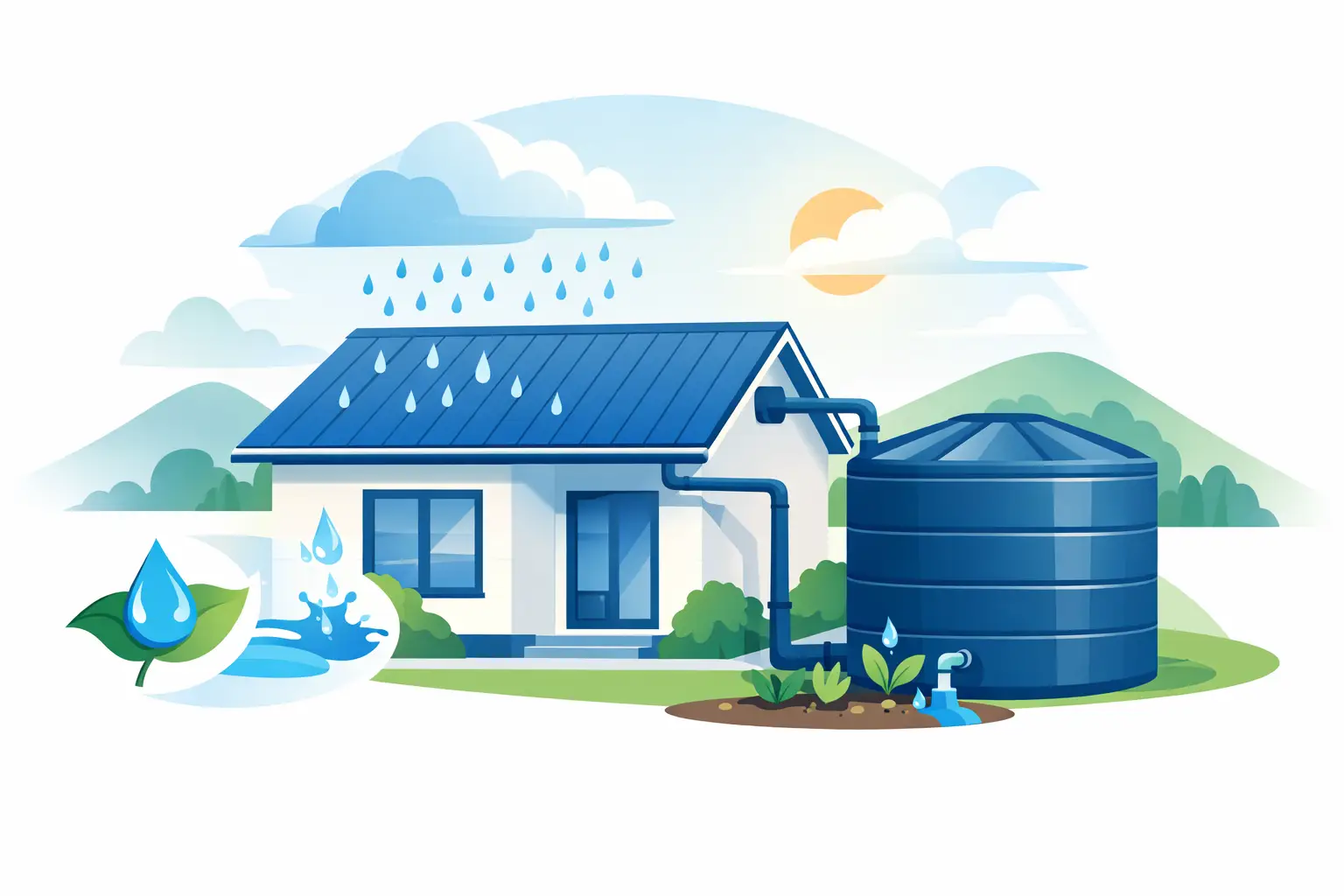
A roof catchment for tank water starts well before the tank arrives on site. The roof, gutters, downpipes and inlet protection all affect how much water you collect and how clean it is when it reaches storage. For homes, farms and acreage properties relying on rainwater, getting these basics right can reduce pump problems, improve water quality and make better use of every decent fall of rain.
Start with your roof area and local rainfall
Your potential water supply depends on three things: the effective roof catchment area, the rainfall your property receives, and the losses in the system. As a useful planning rule, one millimetre of rain falling on one square metre of roof produces one litre of water before allowing for losses.
For example, a 200 m² roof receiving 1,000 mm of annual rainfall has a theoretical yield of 200,000 litres. In practice, allow for water lost through first-flush diversion, gutter overflow, evaporation and light rain that does not create enough runoff. A collection efficiency of around 80 to 90 per cent is often a more realistic starting point for a well-maintained system.
The roof size alone does not determine the right tank capacity. A large roof can fill a modest tank quickly, but that tank may overflow during wet months and run dry during an extended dry spell. Tank sizing needs to consider household demand, livestock or irrigation use, rainfall patterns, available space, budget and whether mains water or another supply is available as backup.
For a household using rainwater as its primary supply, storage is usually selected to carry the property through the longest likely dry period, not simply to hold the volume from one storm. Rural and agricultural properties may need separate storage for domestic water, stock water and fire protection so critical household supply is not affected by seasonal demand.
Choose suitable roof materials for collection
Most sound, well-maintained metal and tiled roofs can be used for rainwater harvesting. Colourbond and similar painted steel roofing are common choices because they shed water efficiently and are straightforward to maintain. Roof condition matters more than appearance. Rusting sheets, deteriorated flashings, damaged tiles and old lead-based materials should be assessed and repaired before they become part of a drinking water catchment.
A new roof can release dust, construction residues and loose material during its first few rains. It is sensible to direct initial runoff away from the tank until the roof has been properly washed by rainfall. The same approach applies after major roof repairs, nearby building work, bushfire ash, extended dry weather or a significant dust event.
Tree cover requires particular attention. Overhanging branches add leaves, blossom, twigs and animal activity to the catchment, while also making gutter maintenance more frequent. Pruning branches back from the roof is often more effective than relying on guards alone. It also reduces the risk of branch damage in high winds.
Gutters and downpipes need enough capacity
Gutters do more than guide water towards the tank. They must manage intense rainfall without overflowing, particularly in coastal and regional areas where storms can deliver heavy rain in a short period. Undersized gutters, poorly positioned downpipes and blocked outlets can send valuable water over the edge before it ever reaches the tank.
Gutters should be correctly graded towards outlets, securely fixed and free of standing water. Downpipes need to suit the roof area and expected flow. Larger roofs commonly require more than one downpipe, and valleys may need additional capacity because they concentrate runoff from multiple roof sections.
Leaf guards can reduce the amount of larger debris entering gutters, but they are not maintenance-free. Fine material can still settle on top or beneath guards, particularly around gum trees. Select a guard that suits the local leaf type and roof profile, and make sure the gutter can still be inspected and cleaned safely.
At the tank inlet, fit a coarse mesh screen to stop leaves, insects and other debris entering the tank. A mosquito-proof mesh is essential. Check it regularly because a blocked inlet screen can restrict flow and cause gutters to back up during heavy rain.
First flush improves roof catchment for tank water
The first runoff from a roof often carries the highest concentration of dust, bird droppings, pollen and other contaminants. A first-flush diverter captures or discards this initial water before cleaner runoff enters the tank. It is a practical component for properties using tank water for drinking, cooking and household supply.
There is no single diverter size for every installation. The appropriate volume depends on roof area, surrounding vegetation, local dust exposure, roof material and how the water will be used. A house in a heavily treed location may need more diversion and more frequent maintenance than an open-site shed catchment.
A first-flush device is only useful if it drains and resets correctly. Inspect the valve, mesh and drain point after rain and clear any sediment. If the diverter remains full or blocked, it can reduce collection efficiency and introduce stagnant water into the system.
Protect the water once it enters the tank
A clean roof catchment is only part of the job. Tank inlets, overflow points and access openings must be screened to stop mosquitoes, frogs, insects and vermin getting inside. The tank lid should fit securely, and light should be excluded where possible to discourage algae growth.
Direct overflow away from the tank base, building footings and areas where it may create erosion. On sloping sites, plan the overflow path before installation. A full tank during a major storm can release a considerable volume of water, and poor drainage can create problems that are expensive to correct later.
For potable use, water treatment should match the water source and the risk level at the property. A sediment filter can protect taps, appliances and pumps from fine particles. Carbon filtration may improve taste and reduce odours. UV sterilisation can provide an additional treatment barrier where water is intended for household consumption, provided the water is adequately pre-filtered and the unit is maintained correctly.
Filtration does not replace good catchment hygiene. If roof debris, animal contamination or sediment are allowed to build up, filters will block more quickly and water quality can decline. The best systems use several layers of protection: a maintained roof, clean gutters, inlet screening, first flush, secure tank access and suitable treatment at the point of use.
Plan the tank inlet, outlet and pump together
The layout between the downpipe and tank should be accessible for inspection. Avoid complicated pipework that is difficult to clean or sections where water can pool. A calming inlet, which directs incoming water towards the bottom of the tank, can help minimise disturbance of settled sediment.
The outlet should draw water from a cleaner level in the tank rather than directly from the bottom, where sediment collects, or the surface, where floating debris can sit. A floating pickup is often a worthwhile option for household water systems because it draws from below the surface where water is generally clearest.
Pump selection needs to reflect the number of outlets, pipe length, elevation changes and the flow expected at the furthest tap. A pump that is too small may struggle when a shower, washing machine and outdoor tap operate close together. One that is poorly matched can cycle excessively and wear sooner. Pressure controllers, pump covers, dry-run protection and correctly sized pipework all contribute to dependable performance.
Keep a simple maintenance routine
Rainwater systems are reliable when small jobs are handled before they become larger ones. Check the roof and gutters after storms, remove leaf buildup as required, and inspect inlet screens and first-flush devices routinely. Look for signs of overflow, leaks, loose gutter brackets or water staining around joins.
At least annually, inspect the tank interior where it can be done safely. Check for sediment, insect entry, damaged mesh, algae growth or changes in water smell and appearance. Tank cleaning may be needed where significant sediment has accumulated or contamination is suspected. Never enter a water tank without appropriate confined-space procedures and professional controls.
Filter cartridges, UV lamps and pump components also have service intervals. Keep a record of replacements and maintenance, particularly where the tank is the main household supply. This makes it easier to identify recurring issues and plan servicing before water quality or pressure is affected.
A well-designed catchment turns your roof into a dependable working asset, not just a surface that sheds rain. If you are planning a new system or improving an older setup, North Coast Water Tanks can help match tanks, pumps, filtration and practical installation advice to the way your property actually uses water.