


A good rainwater harvesting system design starts well before the tank goes on site. Most problems come from sizing that is too small, pumps that do not match demand, or filtration that is treated as an afterthought. If you want reliable water for a home, shed, farm, workshop or commercial site, the design has to suit your roof area, rainfall pattern, daily use and water quality requirements.
In Australia, that matters more than many people expect. Rainfall is often uneven through the year, and two properties in the same district can have very different catchment conditions, storage needs and maintenance demands. A system that works well for a small weekender may fall short on a full-time household, while a basic stockwater setup may not be suitable for potable use without the right treatment.
What a rainwater harvesting system design needs to cover
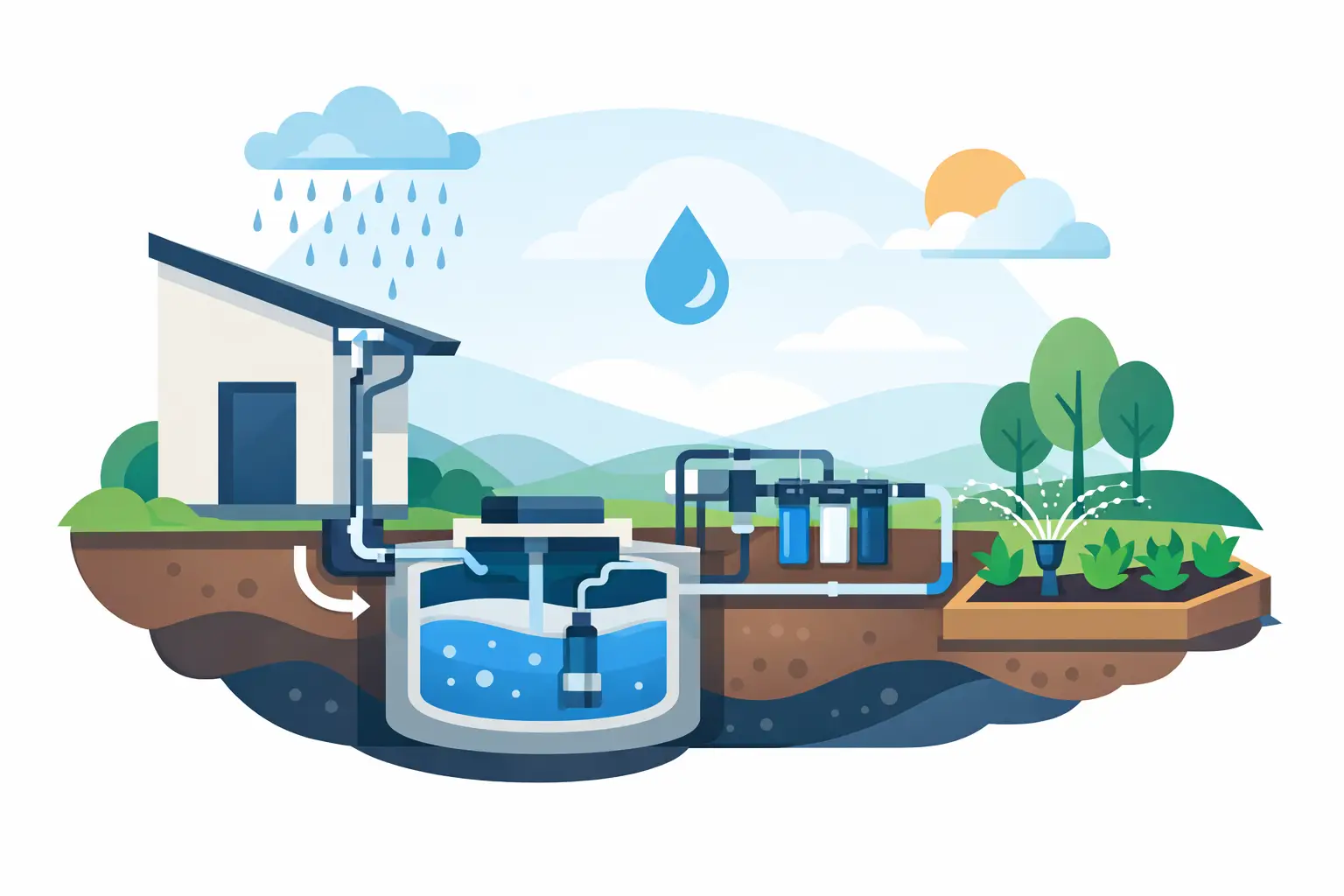
At its simplest, the system has four jobs. It needs to collect water from the roof, move it cleanly to storage, deliver it at the pressure you need, and protect water quality while it is stored and used. That means the design is not just about tank size. It also includes gutters, downpipes, leaf management, first flush devices, tank material, outlet configuration, pump selection, filtration and overflow control.
The trade-offs start early. A larger tank gives more security through dry periods, but it takes more space and budget. A smaller tank may be enough for seasonal use, but if the property relies on rainwater as the primary supply, undersizing usually costs more later. Retrofitting extra storage, changing pipework and replacing an underperforming pump is rarely the cheap option.
Start with water demand, not the tank
One of the most common mistakes in rainwater harvesting system design is choosing a tank first and working backwards. In practice, you get a better result by estimating how much water you need and then checking what your roof can realistically collect.
For a household, demand depends on occupancy, fixture efficiency, garden use and whether rainwater supplies the whole house or only toilets, laundry and outdoor taps. For rural properties, you may also need to allow for troughs, washdown, sheds or seasonal livestock use. On a commercial site, demand can vary sharply depending on staff numbers, process use and peak periods.
This is where local conditions matter. A roof with good catchment area in a high rainfall zone can support a much smaller storage volume than a similar building in a district with longer dry spells. The right answer is rarely a generic rule of thumb. It depends on how long you need the system to bridge between rainfall events and how much backup water is available if the tank runs low.
Calculating catchment and collection efficiency
Roof area is the collection engine of the system. In broad terms, a larger roof captures more water, but not every square metre performs equally. Roof pitch, material, gutter layout and debris loads all affect efficiency. Metal roofing usually provides reliable collection, while older or more complex rooflines can introduce losses and maintenance issues.
You also need to account for the fact that not all rainfall ends up in the tank. Some is lost to first flush diversion, evaporation, gutter overflow and minor inefficiencies. That is why sensible design uses a collection factor rather than assuming 100 per cent capture.
On many properties, improving the catchment side can be as valuable as increasing storage. Extra downpipes, corrected fall in the gutters, leaf screens and properly sized pipework can noticeably improve performance in heavy rain. If water is bypassing the tank during storms, the issue may be conveyance rather than storage.
Choosing the right tank size and material
Tank sizing should reflect both average use and risk tolerance. If your property can switch to mains or another source when needed, you may accept a leaner design. If the tank is your main household or farm supply, you generally need more storage security.
For many Australian sites, a practical approach is to size for dry periods rather than average months. Average figures can look fine on paper while still leaving you short during a long run without meaningful rain. That is especially relevant for acreage homes, farms and small businesses where water interruptions create real operational problems.
Tank material is another design decision with practical implications. Poly tanks are a strong option for many residential and rural applications because they are cost-effective, durable and available in a wide range of capacities. Steel and Aquaplate tanks often suit larger storage requirements, particular site layouts or customer preferences around footprint and appearance. The best choice depends on capacity, access, installation surface, budget and exposure conditions.
Pump and pressure design matters more than people think
A tank full of water is only part of the job. If the pump is poorly matched to the site, the system can be noisy, inconsistent or frustrating to use. Good pump selection comes down to flow rate, pressure, pipe run, elevation change and how many outlets may operate at once.
For a house supply, you need stable pressure for showers, toilets, taps and appliances. For irrigation or washdown, the duty may be quite different. Long pipe runs to sheds, troughs or accommodation can increase pressure losses more than expected, so a pump that looks suitable on a product sheet may struggle once installed.
This is one of the reasons complete system design is worth getting right from the start. The tank, pump and plumbing should be considered together. If you are planning filtration or UV treatment for potable water, that also affects pressure and flow, because treatment equipment introduces resistance that needs to be allowed for.
Filtration and water quality are part of the design
Rainwater quality starts at the roof, but it is protected by the whole system. Clean gutters, effective leaf screening, mosquito-proof inlets and a suitable first flush device all reduce contamination before water enters storage. Once in the tank, good sealing, proper overflow screening and sensible draw-off arrangement help maintain quality.
If the water is for household use, filtration should be specified according to the intended application. Basic sediment filtration may be enough for some non-potable uses, while whole-of-house supply often requires a staged approach, and drinking water treatment may include finer filtration and UV sterilisation. The right setup depends on source quality, end use and maintenance commitment.
There is no single filter combination that suits every property. Heavily treed sites, coastal environments and older roofs may place higher loads on the system. A design that looks economical upfront can become high-maintenance if the filtration is too light for the local conditions.
Overflow, maintenance access and long-term reliability
A reliable system needs to work well in both dry weather and heavy rain. Overflow should discharge safely away from structures, tank foundations and traffic areas. On some sites, directing overflow to a drainage line, swale or secondary storage can reduce erosion and make better use of surplus water.
Maintenance access is often overlooked during planning. Tanks need room for inspection, cleaning and fittings service. Pumps and filters should be installed where they can be reached without turning a routine cartridge change into half a day’s work. If a component is awkward to access, it usually gets neglected.
For long-term performance, design for the site you actually have, not the ideal one on paper. That includes vehicle access for delivery, stable bases, suitable clearances and practical pipe routes. Small decisions at installation stage can make a big difference to service life and operating costs.
When to customise the design
Some setups are straightforward, but many are not. If the property has multiple buildings, mixed water uses, ageing infrastructure or variable occupancy, a standard package may not be the best fit. The same applies where water is needed for both domestic supply and agricultural use, or where tank water must integrate with mains, bore or transfer systems.
This is where experienced guidance has real value. A supplier that understands tanks, pumps, filtration and installation support can help avoid mismatched components and underperforming layouts. For many customers, working with one provider for the full system is simpler and more reliable than piecing it together from different sources.
North Coast Water Tanks works with property owners who need practical, compliant solutions that hold up in real Australian conditions. That kind of support is especially useful when the system needs to balance household reliability, site access, product selection and future expansion.
A better result comes from planning for real use
The best rainwater systems are rarely the fanciest. They are the ones that match storage to demand, move water efficiently, protect quality and stay easy to maintain year after year. If you are planning a new setup or upgrading an older one, treat the design as infrastructure, not just a tank purchase. A system that fits your property properly will save time, reduce headaches and give you far more dependable water when you need it most.