


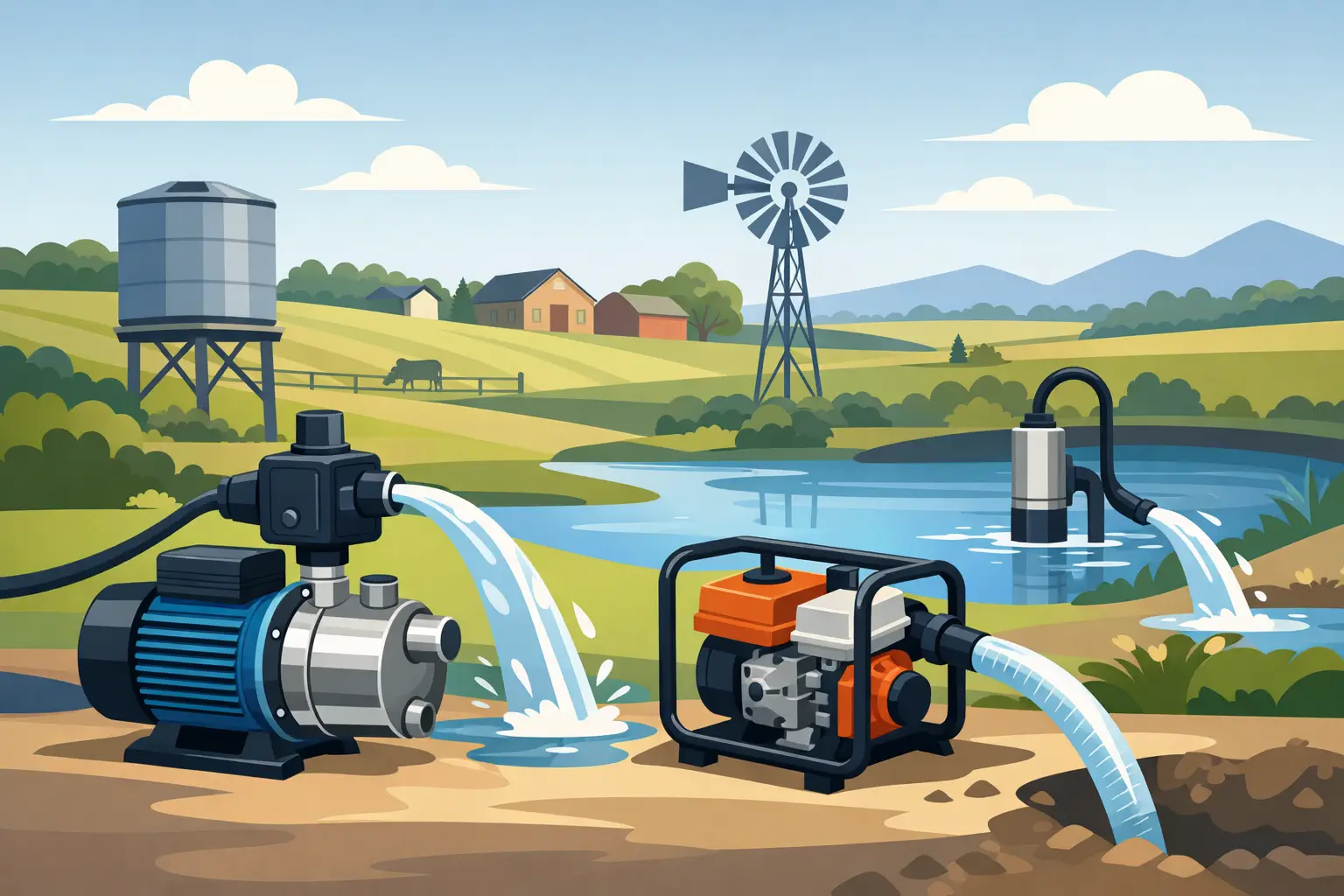
If your pump struggles every time someone turns on a tap while the trough is filling, you are already seeing why choosing the best water pumps for acreage is not a small decision. On a rural or lifestyle property, the pump is what turns stored or sourced water into a usable supply for the house, garden, stock, sheds and irrigation. Get it right and the system works quietly in the background. Get it wrong and you end up with pressure drop, short cycling, higher power use and more maintenance than you bargained for.
What makes a pump suitable for acreage?
Acreage blocks rarely have a simple water setup. You might be drawing from a rainwater tank for the house, transferring water between tanks, running garden irrigation, topping up troughs and feeding a shed or granny flat from the same property. That means pump selection is less about finding the biggest unit and more about matching the pump to the actual job.
The main things that matter are flow rate, pressure, lift, distance and duty cycle. Flow rate is how much water the pump can move. Pressure is what gives you usable performance at taps, showers and sprinklers. Lift is the vertical distance from the water source to the pump or outlet, while pipe run affects friction loss over distance. Duty cycle matters because some pumps handle occasional domestic use well, while others are built for longer operating periods such as transfer or irrigation.
This is where many acreage owners come unstuck. A pump that looks adequate on paper can fall short once you factor in long pipe runs, elevation changes and multiple outlets running at once. A practical pump selection should always be based on the whole system, not just tank size or motor size.
Best water pumps for acreage by application
There is no single best pump for every acreage property. The right choice depends on where the water comes from and what you need it to do.
Pressure pumps for household and general property use
For many acreage homes, a pressure pump is the core of the water system. This type of pump draws water from a tank and delivers it to the house and nearby outlets at consistent pressure. If your property relies on rainwater harvesting, this is usually the first place to start.
A good domestic pressure pump suits properties where water is being used for showers, toilets, laundries, kitchens and light outdoor demand. Multistage pumps are often a strong option because they provide stable pressure and quieter performance than many basic single-stage units. They are well suited to households that want a more consistent feel at the tap, especially when more than one outlet is in use.
That said, not every acreage property needs a high-spec household pump. If demand is modest and the pipe runs are short, a simpler pressure system may do the job well. The trade-off is that lower-cost pumps can be noisier, less efficient or less refined under variable demand.
Transfer pumps for moving water between tanks
On larger blocks, tank-to-tank transfer is common. You may want to move water from a shed tank to a main storage tank, transfer captured rainwater across the property or pump from a dam to a holding tank. In these cases, a transfer pump is usually more appropriate than a domestic pressure pump.
Transfer pumps are built to move water efficiently rather than provide household pressure. They are useful when the job involves volume over distance and when the water is not being delivered straight to taps and fixtures. If the source water is reasonably clean and the transfer route is straightforward, they can be a cost-effective part of an acreage setup.
The limitation is that they are not designed to replace a pressure pump for domestic supply. Trying to use one pump for both jobs can work in some systems, but it often leads to compromise. Where the budget allows, separating transfer and pressure duties usually gives better long-term results.
Submersible pumps for bores, dams and deep water sources
If your acreage property uses a bore, deep well or dam with significant lift requirements, a submersible pump may be the right fit. These pumps sit below the water level and push water upward, which is generally more efficient than trying to pull water over a long vertical distance.
Submersible pumps are a practical choice where suction limitations would affect a surface-mounted pump. They can also be quieter, as the motor is down in the source rather than mounted near the tank or house. For properties with underground water access, they are often the standard option.
The main consideration is service access and application matching. Installation needs to be done properly, and the pump must suit both the water source and the required output. Bore water quality can also affect pump and filtration choices, particularly if there are minerals, sand or sediment involved.
Irrigation pumps for gardens, orchards and pasture
If your acreage includes substantial irrigation, the pump needs to handle a different kind of workload. Irrigation systems often demand higher flow rates over sustained periods, whether you are running sprinklers, drippers or washdown points around the property.
An irrigation pump should be selected around the actual watering layout. Small garden irrigation on a lifestyle block is one thing. Running multiple zones across an orchard or horse property is another. Oversizing can waste power and create control issues, while undersizing leads to poor coverage and disappointing performance.
Where irrigation and household use are both priorities, it is often worth considering separate pump systems. That avoids the common problem of domestic pressure dropping every time irrigation kicks in.
How to choose the right pump size
When people ask about the best water pumps for acreage, they are often really asking about size. Unfortunately, there is no shortcut based on acreage alone. Ten acres with a single home and light garden use may need less pump capacity than two acres with heavy irrigation, stock water and multiple buildings.
Start with your peak demand. Think about how many outlets may run at once, how far the water needs to travel and whether there is any elevation gain from the source to the endpoint. Then consider how often the pump will run and for how long.
Pipe size also matters more than many people expect. A well-sized pump connected to undersized pipe can still perform poorly. The same goes for poor tank outlet configuration, clogged filters or pressure losses through bends and fittings. A pump should be selected as part of the broader water infrastructure, not in isolation.
Features worth paying for
Not every premium feature is essential, but a few are worth serious consideration on acreage properties.
Automatic pressure control is useful for household systems because it starts and stops the pump as demand changes. Dry-run protection can prevent damage if the water source runs low. Thermal overload protection helps safeguard the motor. For properties where noise is an issue, quieter pump design can make a real difference, especially if the unit is close to the house.
Build quality is another area where cheap units often fall short. On acreage, pumps are exposed to dust, weather and frequent use. Durable materials, reliable seals and quality motors generally pay off over time, particularly when replacement or downtime is inconvenient.
Common mistakes acreage owners make
The most common mistake is buying on headline power alone. A bigger motor does not automatically mean better performance. What matters is the pump curve and how it matches your actual system conditions.
Another issue is trying to make one pump do every job on the property. In some setups that is possible, but on many acreage blocks it creates compromise. Domestic water supply, tank transfer and irrigation often have different requirements.
Poor installation planning is another frequent problem. Long suction lines, insufficient weather protection, lack of filtration where needed and badly planned pipework can shorten pump life and reduce performance. Even a quality pump will struggle in a poorly designed system.
When expert advice is worth it
If your property has multiple tanks, mixed water sources, long pipe runs or plans for future expansion, tailored advice can save money and frustration. A pump might seem like a straightforward purchase, but the wrong choice can affect every part of your water system.
This is where dealing with an experienced supplier matters. A business such as North Coast Water Tanks can help match pumps, tanks, filtration and accessories as one working system rather than a collection of separate parts. That is often the difference between a setup that just runs and one that keeps performing through summer demand, dry periods and day-to-day rural use.
The best pump for acreage is the one sized for your water source, your pressure needs and the way your property actually operates. If you start with that approach, you are far more likely to end up with a dependable system that works when you need it most.