



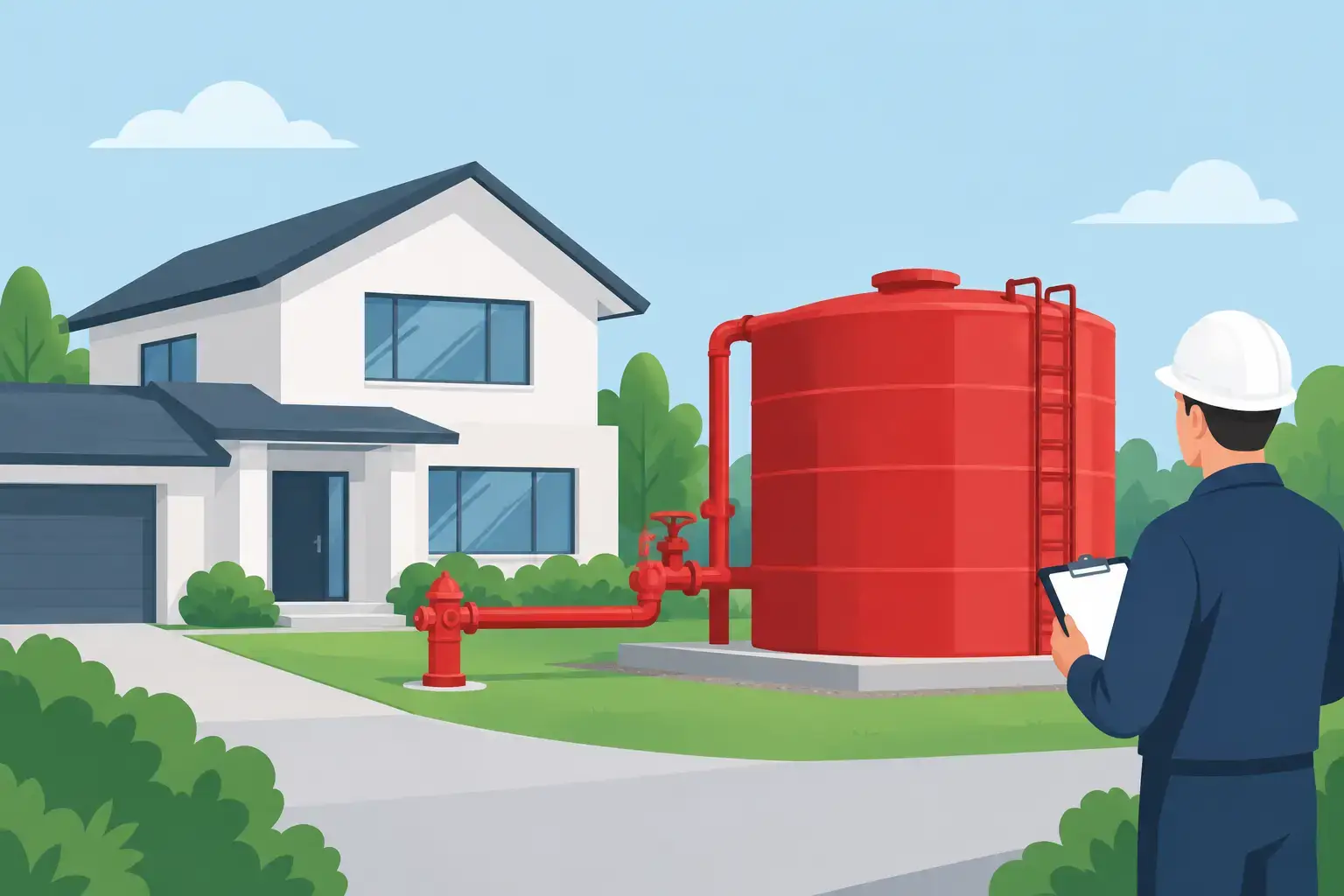
A fire tank is not simply the biggest tank that fits beside the shed. It needs to hold enough dedicated water for fire-fighting, suit the site access available to emergency services, and still work with the rest of your property’s water supply. Knowing how to size fire tank storage correctly helps protect your home, farm assets, livestock and business operations when water matters most.
For rural and regional properties, the right capacity is usually set by a combination of planning conditions, bushfire requirements, insurer expectations and practical site needs. The tank, outlet, pump and hardstand all need to work as one system.
Start with the required fire-fighting water supply
The first step in sizing a fire tank is confirming whether your property has a specified fire-fighting water requirement. This may be included in a development approval, a Bushfire Attack Level assessment, a bushfire management plan, building documentation or a condition from your local council, fire authority or insurer.
Requirements differ between states, councils and property types. A new dwelling in a bushfire-prone area may need a dedicated static water supply, while a farm, workshop, accommodation site or commercial premises may have separate requirements based on its use, building size and fire risk.
Do not assume a neighbour’s tank size will suit your property. Two homes in the same district can have different obligations because of road access, vegetation, building construction, occupancy or approval conditions. If a particular reserve volume is specified, that amount should be treated as water set aside for fire-fighting rather than everyday household or stock use.
Dedicated reserve versus total tank capacity
A tank can store water for household use, irrigation and fire protection, but the fire reserve must remain available when it is needed. For example, if your property requires 20,000 litres of fire-fighting water and your household uses 10,000 litres between significant rainfall events, a 20,000-litre tank alone may not be enough.
In that situation, you need sufficient total storage to retain the required 20,000-litre fire reserve after allowing for normal demand. This can be managed with a larger single tank, separate fire and domestic tanks, or an appropriate outlet arrangement that protects the reserve. The best option depends on your water use, roof catchment and available space.
How to size a fire tank around real water demand
Once the required fire reserve is known, calculate the storage needed above that reserve. Start with your likely water demand during dry periods, not just your average use in a wet month.
For a home, consider drinking, showers, toilets, washing, garden use and any water-intensive appliances. On a rural property, include livestock troughs, wash-down areas, guest accommodation, produce handling, irrigation and water used by staff or visitors. Small businesses should also account for operational water needs and any periods when supply cannot be interrupted.
A practical sizing calculation is:
Total tank capacity = required fire reserve + water needed between reliable refills + contingency allowance
The refill source may be rainfall, bore water, dam transfer or mains backup. Where rainwater is the primary supply, the storage above the fire reserve needs to carry the property through the longest realistic dry spell. In many regional areas, designing around a short-term average can leave the tank low before the next meaningful rain arrives.
A contingency allowance is worthwhile where demand is variable or access is difficult. Carting water during a dry period can be expensive, and it is not a reliable substitute for a protected fire reserve. Extra capacity also gives you more flexibility if household numbers increase, stock numbers change or a dry season lasts longer than expected.
A simple example
Consider an acreage home that is required to retain 20,000 litres for fire-fighting. The household estimates it needs 25,000 litres of usable water during an extended dry period before rainfall can refill the tank. Rather than installing a 45,000-litre tank with no margin, a larger capacity may be the more dependable choice.
A 55,000-litre or 60,000-litre system could provide the 20,000-litre reserve, cover normal demand and leave a buffer for seasonal variation. The final size should still be checked against the roof catchment available. A tank cannot stay full if the roof area and local rainfall do not provide enough water to replenish it.
Check roof catchment and rainfall before going larger
More storage is generally useful, but only when there is a realistic way to fill it. Your roof catchment, annual rainfall pattern and water demand determine whether a larger tank will deliver a practical benefit.
As a broad calculation, one millimetre of rain falling on one square metre of roof produces about one litre of water before allowing for losses. A 200-square-metre roof receiving 800 millimetres of annual rainfall has a theoretical yield of 160,000 litres. Actual collected volume will be lower due to first-flush diversion, gutter overflow, evaporation, wind and rainfall that arrives when the tank is already full.
Seasonality matters as much as the annual total. Coastal areas may receive reliable rain across much of the year, while inland or elevated areas can experience long dry stretches despite a reasonable annual average. A property with a small roof and high water demand may need additional catchment, dam transfer, bore supply or a mains connection to support a large fire tank reserve.
Choose a tank size that fits the site and delivery access
After determining the capacity, confirm that the tank can be delivered, installed and safely supported on the property. A larger tank has a larger footprint, greater filled weight and more demanding site preparation requirements.
A litre of water weighs about one kilogram. A 50,000-litre tank holds around 50 tonnes of water, before allowing for the tank itself. The base needs to be level, stable and prepared to the manufacturer’s requirements. Depending on the tank type and site conditions, this may involve a compacted sand pad, crusher dust base or engineered concrete slab.
Consider access for delivery vehicles, cranes where required, excavation, pipework and future maintenance. Steel and Aquaplate tanks can be a practical option for large capacities or sites with restricted access because they are commonly assembled on site. Poly tanks are often well suited to smaller and mid-sized storage requirements, provided the tank can be delivered to its final location.
Positioning also matters for fire access. If the tank is intended for emergency service use, the outlet or connection point must be accessible, clearly identified and kept free from vegetation, parked vehicles and stored materials. Check the required fitting type, pipe diameter, valve arrangement and any hardstand or turning-area requirements before installation begins.
Size the pump and fittings with the tank
Tank capacity alone does not make a fire water supply effective. The system needs a suitable outlet and, where required, a pump that can deliver adequate flow and pressure. A domestic pressure pump may be suitable for household use but may not meet the needs of a dedicated fire-fighting line or a fire hose setup.
Your design should account for the distance from the tank to the protected buildings, elevation changes, pipe size and the number of outlets required. Long runs of undersized pipe can reduce flow significantly. A correctly sized pump, adequate suction line, reliable power arrangement and accessible isolation valves make the stored water more usable in an emergency.
Where an electric pump is relied upon, consider what happens during a power outage. Some properties use a petrol or diesel fire pump, while others plan for a generator connection or a gravity-fed supply where site levels allow. The right arrangement depends on the property’s risks and the applicable requirements.
Avoid the common sizing mistakes
The most costly mistake is treating the full tank volume as available fire water when everyday use can draw it down. The next is installing a compliant-sized tank without the required connection, access or pump arrangement.
It is also common to underestimate dry-season demand, choose a tank before checking the roof catchment, or place the tank where emergency access is poor. Each issue can limit the value of an otherwise quality installation.
A properly sized fire tank is a long-term piece of property infrastructure. Before ordering, confirm the required reserve, calculate your genuine water demand, check the supply available to refill it and plan the tank, pump and fittings as one system. North Coast Water Tanks can help match practical storage, pumping and filtration options to the way your property actually operates.