



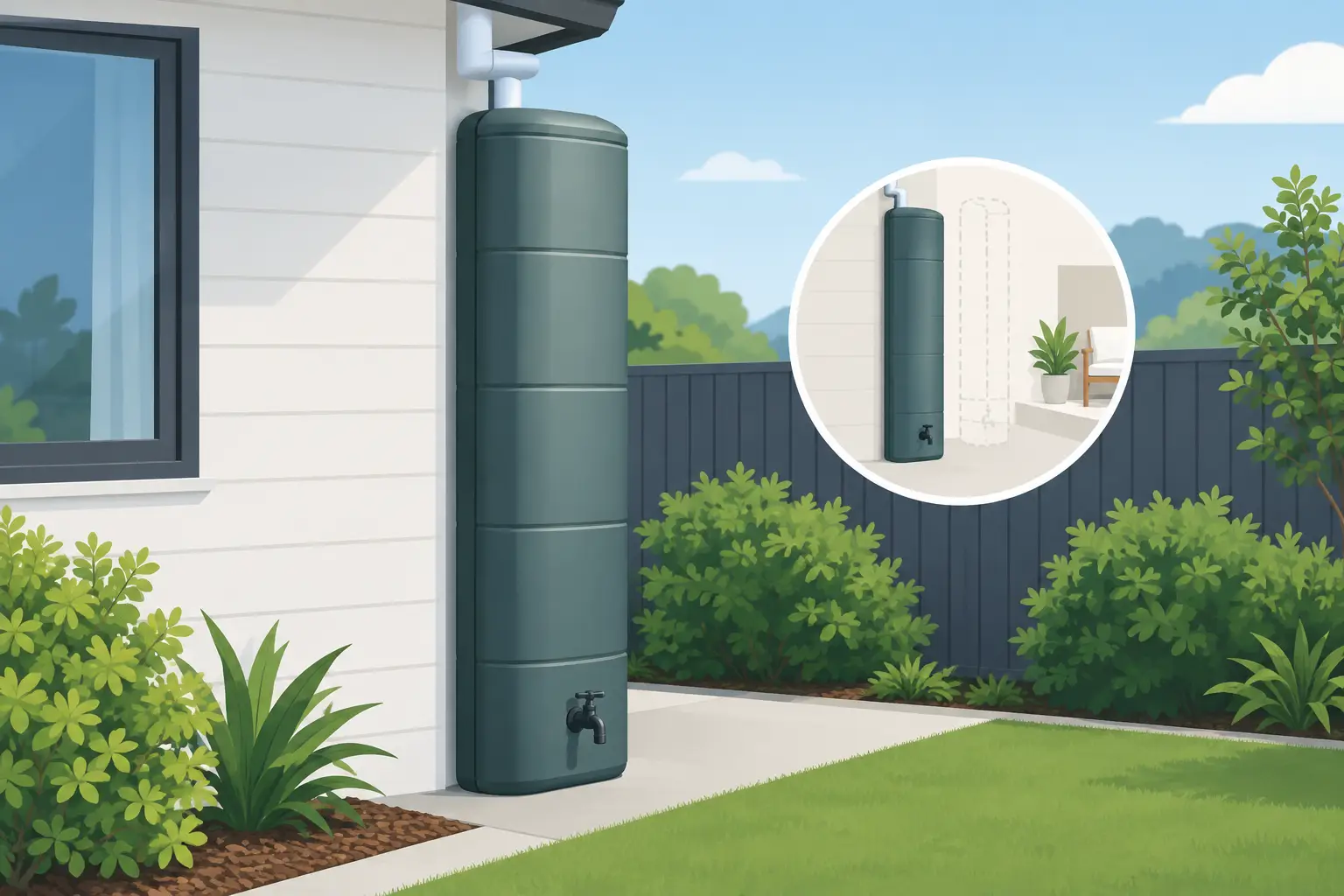
A conventional round tank can be excellent value per litre, but it is not much help if it blocks the driveway, takes over a narrow side yard or cannot fit between the house and boundary. This slimline water tank review looks at where these tanks perform well, where they involve compromise, and what to check before making them part of your rainwater system.
Slimline tanks are designed for sites where available depth is limited. Their long, narrow footprint allows useful rainwater storage along a fence line, beside a garage, behind a shed or under the eaves. For suburban homes, townhouses, small commercial sites and compact rural buildings, that can turn otherwise unused space into a practical water supply.
What a slimline tank does well
The main benefit is placement flexibility. A slimline tank puts storage close to the roof area it serves without dominating the property. This is particularly useful where you want to harvest water from a garage or patio roof, or add capacity to an existing tank system without reworking the whole site.
They also suit staged upgrades. A homeowner may begin with one tank connected to laundry or garden use, then add another tank later as budget and demand allow. On acreage properties, a slimline tank near a workshop, stable or machinery shed can provide a separate supply for wash-down, toilets or stock-related tasks, while larger tanks remain dedicated to household or farm storage.
For many properties, the real value is not simply litres stored. It is the ability to install water storage where it can be plumbed sensibly, accessed for maintenance and used regularly. Water that is easy to capture and draw from is more useful than a larger tank placed in an inconvenient location.
Slimline water tank review: the trade-offs
A slimline tank is not automatically the best option just because the space is tight. Its narrow profile means a smaller footprint in one direction but a longer run along the wall or fence. Before choosing a model, measure the full tank length, width and height, then allow room for inlet pipework, overflow, outlets, pump connections and access to the lid.
Capacity is the other key compromise. Round tanks generally provide more litres for the space they occupy, so they are often the better choice where there is open ground and a high water demand. If your household relies heavily on rainwater, or your farm requires significant storage between rainfall events, a slimline tank may work best as supplementary capacity rather than the entire solution.
Cost per litre can also be higher than for a comparable round poly tank. That does not make it poor value. It simply means the value calculation should include the site constraints. Avoiding excavation, retaining walls, access issues or loss of usable yard space can make a slimline installation the more practical investment.
Capacity should match demand and roof catchment
Do not select a tank by available space alone. Start with what the water will be used for. Garden watering and toilet flushing have a different demand pattern from whole-house rainwater supply. A small business may need water for amenities, cleaning or process use, while rural properties might need a dedicated supply near a shed or outbuilding.
Then consider roof catchment and local rainfall. A very large tank connected to a small roof may take a long time to refill. Equally, a small tank under a broad roof can overflow frequently in wet periods while leaving you short during dry weather. A sensible system balances roof area, expected rainfall, water use and the room available for storage.
In practical terms, it can be better to install two appropriately sized slimline tanks with linked plumbing than force one oversized unit into a difficult position. Multiple tanks offer useful flexibility, but they need correctly planned interconnection, overflow and isolation points so they fill and draw down as intended.
Site preparation is not the place to cut corners
A full water tank is heavy. The base must be level, stable and capable of supporting the entire tank footprint when it is full. An uneven or undersized base can place stress on the tank base and fittings, affect drainage and create problems that are expensive to correct later.
A prepared concrete slab is often a sound option for slimline tanks, especially where access is tight or the surrounding ground may move. Other approved bases may suit particular installations, provided they are prepared to the tank manufacturer’s requirements. The important point is that the tank must sit fully supported, with no unsupported edges, soft spots or debris underneath.
Allow for site drainage as well. Tank overflow should move safely away from buildings, neighbouring properties and the tank base. In heavy rain, poorly managed overflow can erode the surrounding area or send water back towards the house.
Check local planning requirements and boundary clearances before installation. Requirements can vary by council, property type and the way the water is used. If a tank is being connected to household plumbing, especially for drinking water, proper installation and compliant backflow protection matter.
Pumps, filtration and plumbing make the system useful
A tank is only one part of a dependable water system. If you need pressure at taps, toilets, irrigation points or a wash-down hose, choose a pump that suits the required flow, pressure, pipe run and number of outlets. An oversized pump can be noisy and wasteful, while an undersized one can leave showers weak and irrigation ineffective.
For garden-only use, a basic pump and leaf control may be enough. For household supply, the system usually needs more considered filtration. A rain head or gutter guard helps reduce leaf load before water reaches the tank. A first-flush device can divert the initial roof runoff, which often carries dust, leaves and bird droppings. Cartridge filtration can then remove finer sediment before the water reaches household fixtures.
Where rainwater is intended for drinking, food preparation or whole-house use, treatment should be designed around the water source and household needs. UV sterilisation may form part of that approach, but it works best with adequately filtered water. Tank hygiene, clean gutters, correctly sealed access points and regular filter servicing remain just as important.
At North Coast Water Tanks, customers can source tanks, pumps, filtration and the practical advice needed to make those components work together. That one-stop approach is useful because a well-chosen tank can still underperform when the pump, pipe sizing or filtration arrangement has been treated as an afterthought.
Maintenance expectations are straightforward
Slimline tanks are relatively low-maintenance, but they are not fit-and-forget infrastructure. Check screens, strainers and first-flush devices after heavy weather and clear debris before it restricts flow. Keep lids secure and mosquito-proof, and inspect inlet and overflow points for blockages.
Every so often, look around the tank base for signs of movement, pooling water or damage from lawn equipment. Check fittings and valves for slow leaks, especially after periods of high use. If water quality changes, investigate the roof, gutters, tank interior and filters rather than simply replacing cartridges repeatedly.
Tank cleaning intervals depend on the roof environment, surrounding trees, water use and maintenance history. A tank beneath dense foliage or near dusty rural activity will generally need closer attention than one collecting from a clean, well-maintained roof.
Who should choose a slimline tank?
A slimline tank is a strong choice for homeowners with narrow side access, compact blocks, townhouses, garages and shed walls with limited clearance. It is also a useful addition for rural and commercial sites that need localised water storage near a point of use.
Choose a round tank instead if maximum storage per dollar is the priority and there is enough clear land for it. Choose a slimline model when physical space is the limiting factor and you still want reliable rainwater capture. The best tank is the one that fits the site properly, is supported correctly and connects to a system you can maintain with confidence.
Before ordering, measure twice, map the pipework and decide exactly how the water will be used. That small amount of planning is what turns a narrow strip beside the house into dependable storage for years to come.