


If your tank water has started to smell off, look cloudy, or leave sediment in the bottom of a bucket, the problem usually started well before you noticed it. A professional water tank cleaning service is not just about making a tank look clean. It is about protecting water quality, keeping your storage system working properly, and avoiding larger maintenance issues across pumps, filters and household supply.
For many Australian households, farms and small commercial sites, stored water is not a backup. It is the main supply. That changes the way tank maintenance should be viewed. Cleaning becomes part of running reliable infrastructure, not a once-in-a-decade job you only think about after heavy rain, drought break sediment, or a complaint about taste.
When a water tank cleaning service is worth booking
A tank does not need to be visibly filthy to need attention. Fine sediment, leaf matter, insect activity and sludge can build up gradually, especially in systems collecting roof water year after year. If the tank has never been cleaned, if the property has changed hands, or if there has been a roof contamination event such as smoke, bird droppings, vermin activity or storm debris, cleaning is often the sensible next step.
There are also performance signs that point to the tank rather than the pump or filtration equipment. Water discolouration, unusual odour, reduced flow caused by intake blockage, repeated filter clogging and visible debris at outlets can all indicate material sitting in the base of the tank. In concrete tanks, ageing surfaces and internal deterioration may also contribute to water quality issues. In steel, poly and lined tanks, the trigger is more often contamination entering from above and settling over time.
That said, not every tank needs cleaning on the same schedule. A well-sealed tank with effective first flush diversion, good leaf screening and a clean catchment area may go much longer between services than an older system with poor strainers and overhanging trees. The right timing depends on tank type, water source, usage and how critical the stored supply is to the property.
What happens during a water tank cleaning service
A proper service starts with inspection, not guesswork. The contractor should assess the tank condition, access, water level, internal contamination, inlet and outlet points, and any obvious issues with lids, strainers, overflows or surrounding pipework. If there are signs of structural problems, failed liners, corrosion or concrete deterioration, cleaning alone may not solve the underlying issue.
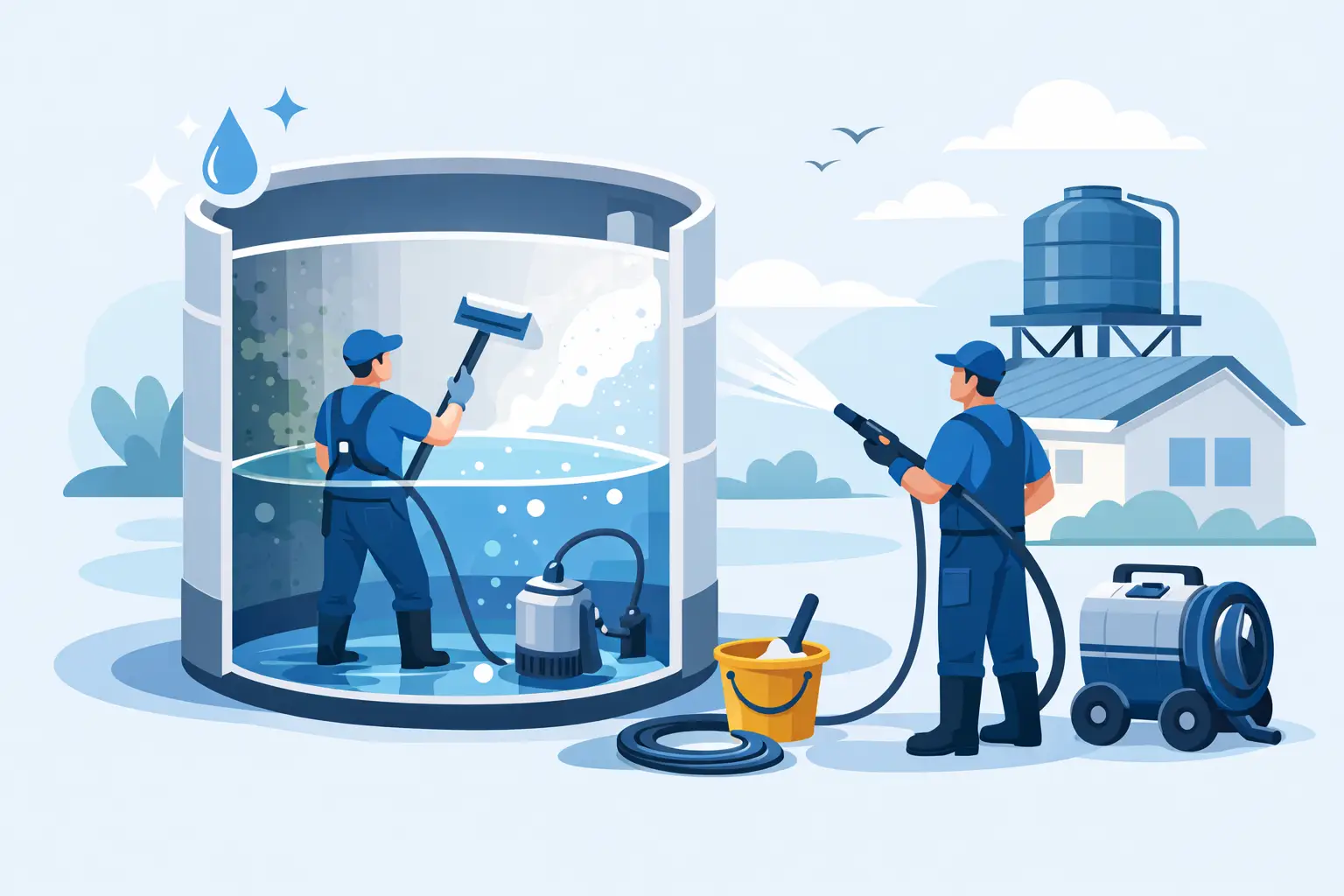
The cleaning process itself can vary depending on tank material and site conditions, but the goal is consistent – remove settled sludge, organic matter and contaminants without causing damage to the tank or connected equipment. In many cases, this involves controlled removal of dirty water and sediment, internal washdown or vacuum extraction, and inspection of the floor and walls once debris is cleared.
For potable water systems, hygiene matters at every stage. The service should be carried out with equipment suitable for water storage applications, and any disinfection step should be appropriate to the tank use and material. Overdoing chemical treatment is not always the answer. In some systems, especially where filtration and UV treatment are already in place, the focus is on physically removing contamination and restoring the tank to a manageable, hygienic condition.
A good operator will also look beyond the inside of the tank. There is little value in cleaning out sludge if leaf matter is still entering through a damaged strainer, if the tank lid is not sealed properly, or if the guttering is feeding in constant organic load. The best service outcomes come when tank cleaning is paired with practical maintenance advice.
Why cleaning is about more than appearance
Sediment at the base of a tank does not just sit there harmlessly. Organic matter breaks down. Nutrients accumulate. Bacteria can multiply more easily in neglected storage, particularly where warm conditions and poor sealing allow contamination from insects, vermin or surface runoff. Even when the water still looks acceptable, build-up can affect taste, odour and downstream treatment performance.
This matters most where tank water is used in the home, in staff facilities, in stock watering systems or in any setting where dependable quality is expected. Filters can help, and UV sterilisation can be highly effective in the right setup, but neither should be treated as a substitute for tank hygiene. Filtration systems perform better when they are not constantly dealing with excess sediment and organic load from an overdue clean.
There is also a mechanical side to the issue. Sediment can block foot valves, affect pump strainers and shorten the service life of filtration cartridges. If you are replacing filters too often or troubleshooting pump issues repeatedly, the tank itself may be part of the problem. Cleaning can reduce that pressure on the rest of the system.
How often should a tank be cleaned?
There is no single answer that suits every property. Some tanks may need inspection every year and cleaning every few years. Others, particularly in clean catchment conditions with strong preventative measures, may go longer. Rural properties with dusty environments, heavy tree cover or variable roof conditions often need closer monitoring than suburban systems with newer infrastructure.
Usage patterns matter too. A tank supplying a full household or commercial operation sees more turnover than one used occasionally for garden water. High turnover can be positive because water does not sit as long, but it can also mean contamination issues show up faster because the system is under regular demand.
If you are unsure, inspection is the practical starting point. It is better to assess the actual condition than to rely on a rough timeline. This is especially true for properties that depend entirely on stored rainwater, where water quality is directly tied to daily living and business continuity.
What to check before you book
Not every contractor offering cleaning has the same experience with water storage systems. It is worth asking what tank types they work on, whether they handle potable water tanks, and whether they can identify related issues such as damaged liners, failing valves, poor inlet screening or concrete repair needs. A cleaner who understands the whole system can save time and prevent repeat work.
It also helps to confirm access requirements and whether the tank needs to be partially emptied beforehand. Some sites are straightforward. Others involve difficult access, large-capacity rural tanks, multiple connected tanks or integrated pump and filtration setups that need to be managed carefully during service.
If the tank is part of a broader water system, choose a provider who can give practical advice on the next step after cleaning. That might mean upgrading strainers, replacing a first flush diverter, checking pump protection, adding filtration or reviewing whether UV treatment is appropriate. A one-off clean is useful. A maintained system is better.
Preventing the next contamination cycle
The most cost-effective cleaning job is the one you do not need to repeat too soon. Simple preventative measures make a real difference – secure lids, mosquito-proof screens, clean gutters, effective first flush devices and regular visual checks after storms or heavy leaf fall. These are not expensive upgrades compared with dealing with contaminated water supply or avoidable pump and filter wear.
For older tanks, prevention may also mean addressing the tank structure itself. Cracked concrete, rusted fittings, degraded seals or damaged liners can keep reintroducing problems. In those cases, cleaning is only one part of restoring safe, usable storage.
This is where working with a supplier that understands tanks, filtration, pumps and maintenance as one connected system has real value. North Coast Water Tanks supports property owners who need more than a basic washout – they need practical advice, quality products, and local support that matches the way their water system is actually used.
If your stored water is there for drinking, washing, livestock, irrigation or day-to-day operations, keeping the tank clean is not over-servicing. It is part of looking after an asset you rely on every week, in every season, when the next rainfall event is never something you can fully control.