


If your tank water looks clear but you are still not fully confident using it for drinking, cooking or whole-house supply, that is usually where a UV water steriliser for tank water comes into the picture. Clear water is not always microbiologically safe, and for many households, farms and rural properties, UV is the final treatment step that turns stored rainwater into a more dependable everyday water source.
Why tank water often needs more than basic filtration
Tank water systems do a good job of collecting and storing rainwater, but storage alone does not sterilise it. Bird droppings on roofing, leaf litter in gutters, organic matter in the tank and warm weather can all contribute to microbial contamination. Even a well-maintained system can be exposed to bacteria, viruses and parasites over time.
This is why relying on appearance alone is risky. Water can taste fine, look fine and still carry contaminants you cannot see. Sediment filters improve clarity and protect pumps and appliances, but they do not necessarily neutralise microorganisms. If the water is intended for household use, especially as drinking water, UV treatment is often the practical next step.
What a UV water steriliser for tank water actually does
A UV water steriliser exposes flowing water to ultraviolet light at a specific wavelength. That light damages the DNA of microorganisms, stopping them from reproducing and making them ineffective as disease-causing organisms.
In practical terms, UV treatment targets the microbiological side of water quality. It is commonly used to reduce bacteria such as E. coli and can also be effective against other pathogens when the system is correctly sized and the water entering it is properly filtered.
It is worth being clear about what UV does not do. It does not remove sediment, improve taste caused by dissolved minerals, or correct chemical contamination. That is why a UV unit is usually part of a broader treatment setup rather than a stand-alone fix for every water quality issue.
Where UV fits in a tank water system
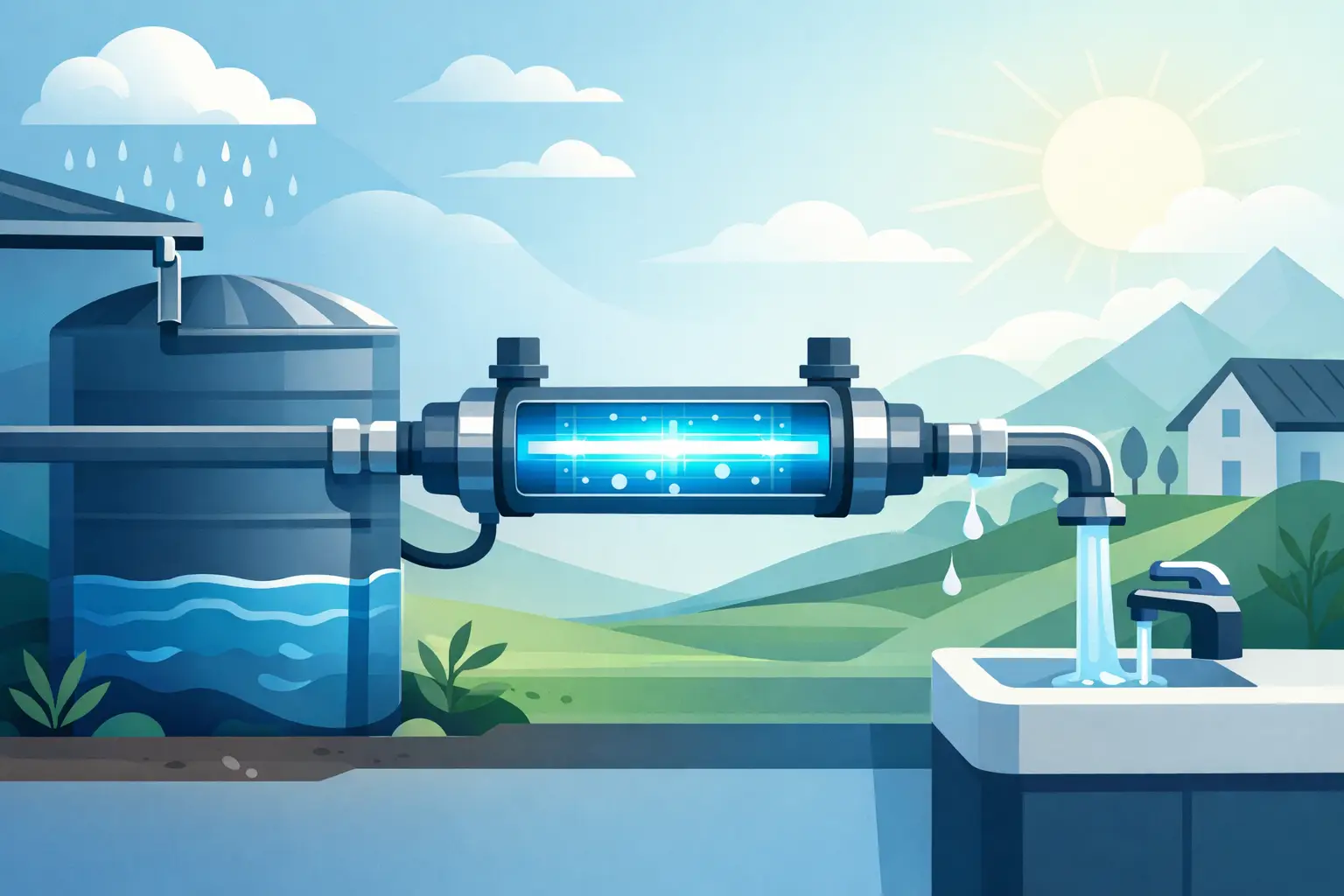
For most properties, UV should be installed near the point where water enters the house or the section of the system supplying drinking-quality water. The usual order is tank, pump, filtration, then UV. That sequence matters.
If water reaches the UV chamber with too much sediment or turbidity, the light cannot penetrate effectively. Particles can shield microorganisms from exposure. In other words, the UV unit may be working perfectly, but the water quality going into it limits the result.
That is why pre-filtration is essential. A typical setup may include a sediment filter and, in some cases, a carbon filter ahead of the UV system. The exact combination depends on your water source, the condition of the tank and pipework, and whether the supply is for a house, shed, dairy, workshop or accommodation.
When UV is a sensible choice
A UV system is a strong option when rainwater is your main household supply and you want added protection without dosing the water with chemicals. Many property owners prefer UV because it treats water as it passes through the system and does not leave a residual taste or odour.
It also suits situations where water quality is generally good but there is a clear need to manage microbial risk. That includes homes using tank water for drinking, kitchen use and bathrooms, as well as rural properties where roof catchment conditions can vary through the seasons.
It may be less suitable as the only treatment method where water is heavily contaminated, poorly filtered or subject to ongoing sediment problems. In those cases, the better answer is to correct the broader system first rather than expecting the UV unit to compensate for upstream issues.
Choosing the right UV water steriliser for tank water
Sizing a UV unit is not just a matter of matching it to your tank size. The more important factors are flow rate, intended use and incoming water quality. A household supplying several taps, showers and appliances at once needs a different setup from a shed sink or a small off-grid cabin.
The system must be able to deliver the required UV dose at the actual peak flow rate. If the flow through the unit exceeds its rated capacity, contact time drops and treatment performance can be compromised. This is one of the most common mistakes in DIY system selection.
You also need to think about pressure loss, filter compatibility and maintenance access. A compact unit might fit the wall, but if the lamp cannot be serviced easily or the pre-filters are undersized, the setup becomes frustrating and expensive to run.
For that reason, good system design matters as much as the UV chamber itself. Matching the UV unit to the pump, filtration stages and household demand is the difference between a reliable installation and one that gives inconsistent results.
Installation details that make a real difference
A UV system should be installed in a protected location, generally out of direct weather and with enough room to change lamps and filters. It also needs a stable power supply. If your property experiences outages, it is worth considering how the system will behave when power is interrupted and whether alarms or shut-off features are needed.
Orientation and plumbing layout matter too. The unit must be installed according to manufacturer requirements, and the surrounding pipework should allow for isolation, servicing and bypass where appropriate. If you cannot isolate the unit easily, even routine maintenance becomes a job you put off.
There is also the issue of downstream contamination. If old pipework, dead legs or poorly maintained taps sit after the UV point, water quality at the outlet may not reflect the treatment performance inside the chamber. In some systems, sanitising the downstream lines during commissioning is a sensible step.
Maintenance is not optional
UV is low-chemical treatment, not no-maintenance treatment. The lamp generally needs periodic replacement even if it still glows, because UV output drops over time. Quartz sleeves can also develop staining or fouling, reducing the amount of UV light reaching the water.
Pre-filters need regular replacement as well. If they clog, flow is affected. If they are left too long, water quality heading into the UV unit can decline. Many performance complaints traced to UV systems actually come back to neglected pre-filtration.
This is where a practical service schedule pays off. If the system protects your main household water, maintenance should be treated as routine infrastructure care, much like checking your pump or cleaning gutters. A quality unit installed properly will do its job, but only if it is kept in proper operating condition.
Common questions from tank water users
One common question is whether UV makes tank water safe on its own. The honest answer is it depends on the condition of the source water and the rest of the system. UV is highly effective for microbiological treatment when the water is already well filtered and the unit is correctly matched, but it does not replace sediment management, tank hygiene or sensible system design.
Another question is whether chlorination is better. For some applications, chemical disinfection has a place. It can provide a residual effect in stored water, which UV does not. But many households prefer UV because it avoids chemical taste and works well as a point-of-entry treatment method. The right choice depends on how the water is stored, how it is used and what risks need to be managed.
People also ask if they need UV when they already have clean gutters and first flush devices. Those measures are very worthwhile, but they reduce contamination risk rather than eliminate it. Good catchment management, clean tanks and proper filtration all improve the system. UV adds another layer of protection where human consumption is involved.
A practical approach for Australian properties
Australian tank water systems deal with real-world conditions – heavy rain after dry spells, leaf load, warm tanks, changing demand and long pipe runs across rural blocks. That is why the best setup is rarely the cheapest single component. It is the system that works reliably through the year and suits the property.
For many homes and farms, that means treating UV as the final barrier, not the whole answer. Start with the catchment, keep gutters and strainers clean, maintain the tank, choose suitable pre-filtration, and then install a UV unit that matches actual demand. Done properly, it gives you a dependable treatment step without complicating everyday use.
With more than 30 years working with tank, pump and filtration systems, North Coast Water Tanks sees this regularly: the right UV setup is less about chasing a product and more about getting the whole water system to work together. If you are using tank water for household supply, a properly specified UV unit is one of the clearest upgrades you can make for confidence at the tap.
The useful question is not simply whether you need UV. It is whether your current tank water system gives you enough certainty every time someone fills a glass, turns on a shower or runs the kitchen tap.