


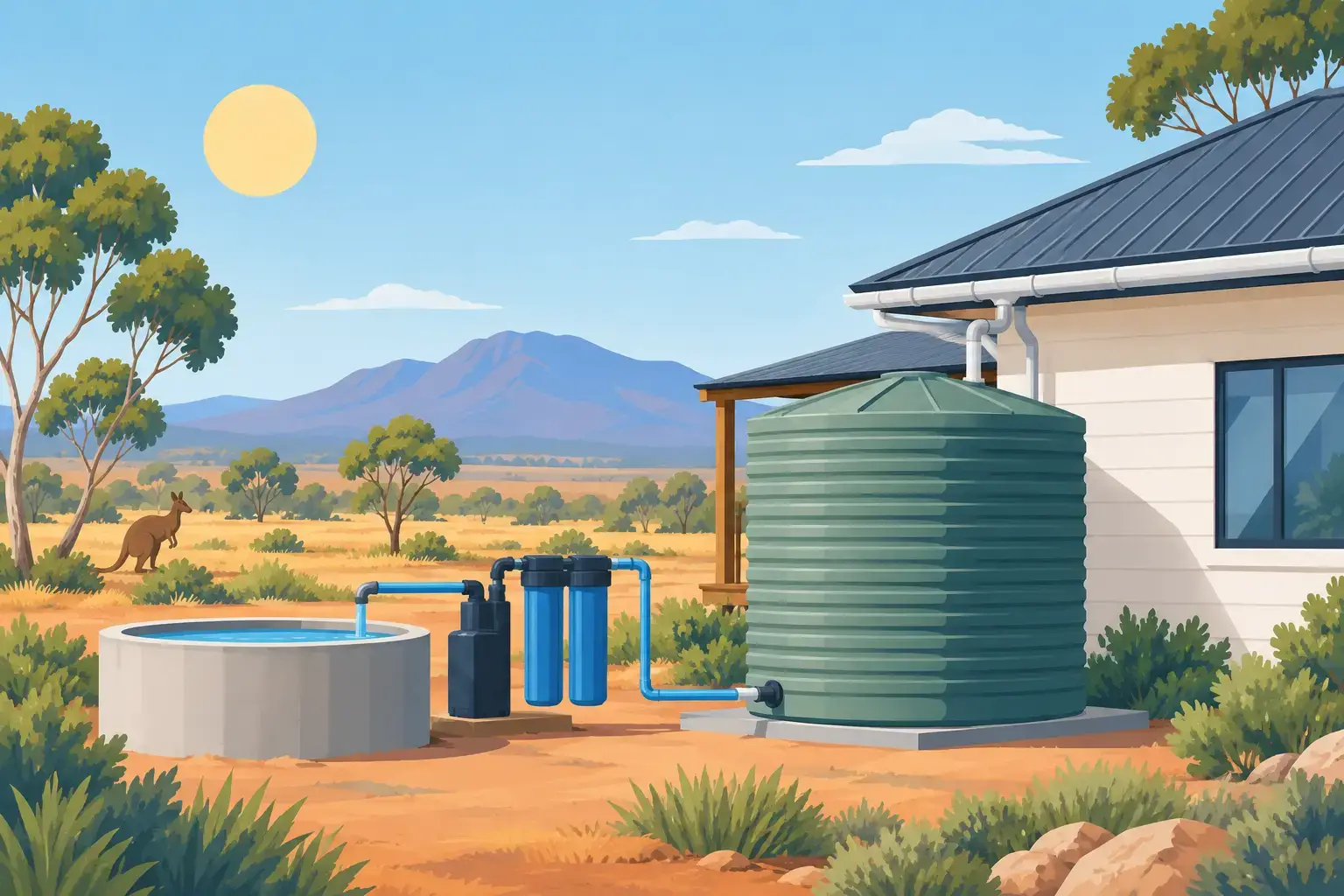
A reliable off grid water supply guide starts with one practical question: how much water can your household, livestock or business afford to use between meaningful rainfall? On an acreage, rural block, tiny home or remote worksite, water storage is not simply a tank purchase. It is a complete system that must collect water, store it safely, deliver it at useful pressure and protect its quality.
The best system is sized for dry spells, not the last good downpour. It also allows for changing household numbers, garden demands, stock water and seasonal conditions. Planning these details early will help you avoid undersized tanks, an overworked pump and expensive alterations later.
Start with your daily water demand
Your water requirement drives every major decision: tank capacity, roof catchment, pump size and treatment equipment. Begin by estimating normal daily use, then separate essential water from discretionary use.
For a household, essential demand may cover drinking, cooking, showers, toilets, laundry and basic cleaning. Rural properties may also need water for animals, wash-down areas, irrigation, firefighting reserves or a separate dwelling. A family that is careful with water can use considerably less than a household with long showers, large gardens and frequent visitors, so generic figures only go so far.
Track your current metered use if possible, or review water bills over several seasons. Where that is not available, make a realistic allowance for each person and each water-using activity. Include peak periods such as school holidays, harvest, calving, holiday rental occupancy or extended dry weather.
Once you have a daily figure, multiply it by the number of days you need to bridge without reliable rain. This gives a useful starting point for storage. In many Australian locations, allowing for several months of low rainfall is sensible, but the right period depends on local rainfall patterns, roof area, available space and whether another supply is available.
Match tank capacity to roof catchment
A large tank cannot fill if the catchment is too small. Your roof is usually the most dependable collection surface, and its effective area matters more than the size of the block.
A simple annual estimate is roof area in square metres multiplied by annual rainfall in millimetres. One millimetre of rain falling on one square metre produces one litre of water. Then allow for losses from first-flush diversion, gutters, overflow, evaporation and inefficient collection. The usable yield will always be lower than the theoretical figure.
For example, a 200 square metre roof receiving 1,000 mm of rain has a theoretical annual yield of 200,000 litres. That may sound substantial, but rainfall rarely arrives evenly through the year. Tank sizing must account for the timing of rain as well as the annual total.
Where site access permits, two or more tanks can be a practical option. Multiple tanks can be positioned close to separate roof areas, allow staged expansion and provide some reserve if one tank needs cleaning or repair. Poly tanks are commonly chosen for their corrosion resistance and installation flexibility, while steel and Aquaplate tanks can suit larger capacities and particular site requirements. The right material depends on capacity, access, foundations, appearance and budget.
Allow for overflow and site drainage
Every tank needs a controlled overflow path. Direct excess water well away from the tank base and building footings, and avoid creating erosion or waterlogging around sheds and access tracks. On sloping sites, think through where water will travel during a heavy coastal storm, not just during a light shower.
Tank pads must be level, compacted and properly prepared for the full weight of a filled tank. Water weighs one kilogram per litre, so a 22,500 litre tank holds more than 22 tonnes before the tank itself is considered. A sound base is a long-term reliability issue, not an optional extra.
Build an off-grid water supply that protects water quality
Rainwater can be an excellent household supply when the collection and storage system is maintained properly. Keeping contaminants out is more effective and less costly than trying to remove them after they reach the tank.
Fit gutter protection suited to your roof and surrounding trees, and keep gutters clear of leaves, nesting material and accumulated debris. A first-flush device helps divert the initial runoff that may carry dust, bird droppings and other contaminants from the roof. Screens on inlets and overflows help keep insects, frogs and vermin out of the tank.
For drinking water, treatment should reflect the actual source water, household needs and health risk. Sediment filtration can protect plumbing and improve water clarity. Carbon filtration may reduce taste and odour issues. UV sterilisation can provide an additional barrier against microorganisms, but it works best when water is already clear and filtered. UV lamps and filter cartridges need scheduled replacement, so choose equipment you are prepared to maintain.
If water quality is uncertain, particularly after floodwater intrusion, bushfire ash, animal contamination or a long period without maintenance, arrange testing before relying on it for drinking. Treatment systems should be installed and maintained according to the manufacturer’s requirements and applicable Australian requirements. If your property has a mixed supply, clearly identify drinking-water lines and non-potable lines.
Choose a pump for pressure, distance and demand
A pump is often where an otherwise well-planned system falls short. Selecting on horsepower alone can leave you with poor shower pressure, excessive cycling or a pump that cannot deliver water to an elevated house or distant trough.
Pump selection depends on flow rate, pressure, vertical lift and friction losses through pipework. A single house with standard fixtures has different needs from a homestead supplying several bathrooms, a dairy wash-down point and stock troughs across the property. Long pipe runs, undersized pipe and elevation changes all reduce performance.
A pressure pump with an appropriate controller is common for household rainwater systems. It should be protected from weather, installed where it can be serviced easily and paired with correctly sized pipework. Dry-run protection is worthwhile where tanks may run low. For larger or more complex systems, a pressure vessel or variable-speed arrangement may reduce pump cycling, although the best setup depends on the demand pattern and system design.
Do not overlook power resilience. If the property is fully off-grid, confirm that the pump’s starting load is compatible with the solar, battery and inverter system. A water supply that only works while the generator is running is not necessarily a practical household supply.
Plan for drought, fire and equipment failure
A dependable off-grid system has more than one response when conditions turn against it. This might be a second tank, a bore connection, carted-water filling point, creek or dam supply for non-potable use, or a carefully managed reduction in household demand. The suitable backup depends on water quality, approvals and the reliability of each source.
If you need water reserves for firefighting, keep that volume separate in your planning. Water that is counted for firefighting cannot also be assumed available for household use during a dry summer. Check local planning requirements, insurance conditions and fire service guidance before finalising tank capacity, fittings and access arrangements.
It is also wise to fit isolation valves so parts of the system can be serviced without shutting down the whole property. Keep a small supply of practical spares, such as filter cartridges, O-rings and compatible fittings. These are minor items until a failed seal or blocked filter occurs on a weekend.
Set a maintenance routine you will actually follow
Off-grid water systems reward simple, regular maintenance. Inspect gutters, leaf screens, inlet strainers, overflows and pump operation after major weather events. Check for leaks around fittings and listen for a pump that starts when no tap is running, which can indicate a pressure loss or faulty valve.
Tank cleaning frequency depends on the condition of the roof, gutters and water inside the tank. Sediment build-up, odour, discoloured water or repeated filter blockages are signs that inspection is due. Cleaning, repairs and upgrades are easier when tanks have safe access points and pipework is laid out with future servicing in mind.
North Coast Water Tanks can assist with the practical pieces of a complete setup, from water tanks and liners to pumps, filtration, accessories and maintenance support. Getting advice before installation can prevent mismatched components and make later expansion far simpler.
A well-designed supply gives you more than stored water. It gives your household or operation room to handle dry weather, power interruptions and the ordinary wear of rural life with fewer surprises.