


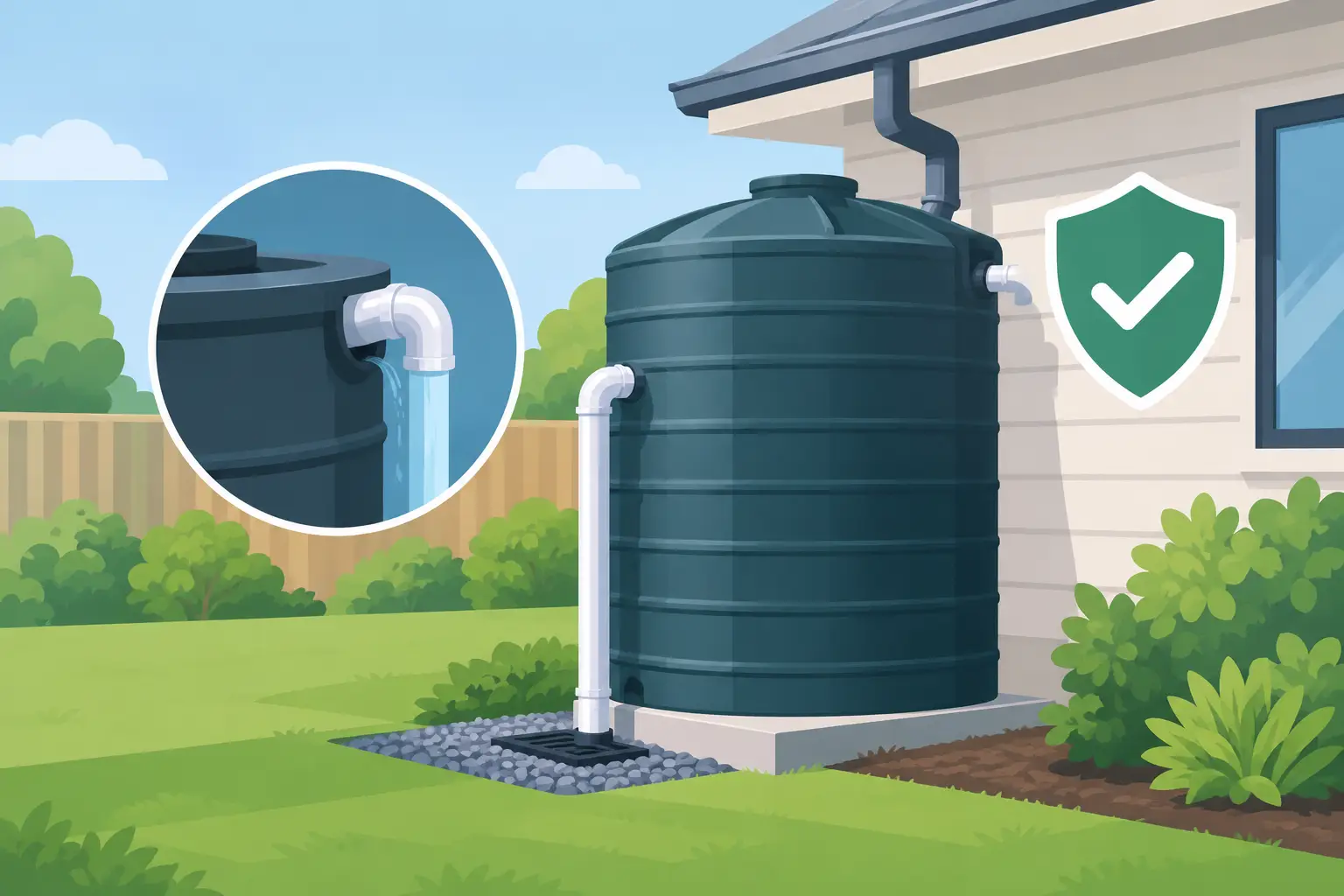
A full tank is a good result – until the next heavy downpour sends water across a driveway, under a shed, or against the house. Effective tank overflow solutions give surplus rainwater a controlled path away from your tank and buildings, protecting the property while allowing your rainwater harvesting system to keep doing its job.
For homes, farms, acreage blocks and commercial sites, an overflow should never be an afterthought. The right arrangement depends on tank capacity, roof catchment area, soil type, slope, nearby structures and local stormwater requirements. A small suburban tank may only need a correctly positioned overflow connected to a lawful drainage point. A large rural storage system may need erosion protection, swales, diversion drains or a plan to move excess water into a second tank.
Why tank overflow needs proper planning
Every rainwater tank needs an overflow outlet. Once water reaches the maximum storage level, incoming roof water has to leave the tank freely. If it cannot, pressure can build at the inlet, water can back up through gutters, and the tank, roof plumbing or surrounding ground can be put under unnecessary stress.
Overflow problems are often noticed after a major rain event, but the cause is usually a design or maintenance issue that has been there for some time. Common examples include an undersized pipe, a blocked outlet, a discharge point too close to the tank, or water directed onto ground that cannot absorb it quickly enough.
A sound overflow arrangement should do three things: allow water to exit without restriction, carry it safely away from the tank foundation and structures, and discharge it where it will not create erosion, flooding or nuisance for neighbouring properties.
Overflow is not the same as a leak
A tank overflowing during sustained rain is normal when it is already full. Water leaking from a fitting, seam, valve or damaged pipe is not. Checking the difference matters because the fix is entirely different.
If water is coming from the designated overflow outlet only when the tank is full, inspect where that water is travelling. If it is escaping from another part of the system, arrange an inspection and repair before the issue worsens.
Start with the overflow outlet and pipework
The tank manufacturer’s overflow connection is the starting point. It should remain clear, correctly fitted and sized to suit the tank and the expected inflow from the roof. Do not reduce the outlet size or fit a setup that restricts water flow simply to make the pipework easier to route.
The overflow pipe should run downhill where possible, with smooth bends and adequate support. Sharp turns, sagging pipework and makeshift joins can collect debris and slow discharge when the system is under pressure from heavy rain. The outlet also needs to be protected from leaves, vermin and insects without creating a blockage risk. Use fittings designed for tank overflow applications and inspect them regularly.
Where a tank is fed by a large roof area, the overflow system deserves particular attention. A 22,000-litre tank can fill quickly during a coastal storm if the catchment is substantial. The tank volume does not determine overflow demand on its own – roof area and rainfall intensity matter just as much.
Keep the inlet and gutters working as intended
An overflowing tank may be doing exactly what it should, while blocked gutters or a poorly maintained inlet are making the result look worse. Leaves, twigs and roof debris can cause water to bypass guttering, spill around the tank inlet or accumulate at screens and strainers.
Clean gutters, leaf guards, tank strainers and first-flush components on a regular schedule, particularly before the wetter months. A first-flush diverter can improve water quality by keeping the first dirty roof runoff out of the tank, but it is not a replacement for a properly sized overflow line.
Direct excess water away from buildings and tank bases
The discharge location is where many tank overflow solutions succeed or fail. Water should not be allowed to pool beside the tank stand, concrete pad or compacted tank base. Persistent saturation can soften surrounding ground, contribute to erosion and make access unpleasant or unsafe.
Keep overflow water clear of house footings, sheds, retaining walls, septic areas, driveways and other locations where concentrated water can cause damage. On sloping blocks, take extra care that the discharge does not cut a channel down the hill or run towards a neighbouring property.
For many sites, the simplest reliable option is a solid overflow line leading to an approved stormwater connection or suitable legal point of discharge. This approach is often appropriate in built-up areas, provided the work meets local council requirements and applicable plumbing rules.
On larger properties, controlled surface drainage can be more practical. A shallow grassed swale, spoon drain or carefully located diversion channel can slow and spread water across a stable area. The aim is not to hold water against the tank. It is to move it away gently enough that the soil and vegetation can handle it.
Use erosion protection where water leaves the pipe
Water discharged from a pipe can scour soil surprisingly quickly, especially on sandy ground or exposed slopes. If the outlet empties onto soil, install suitable energy dissipation such as a rock apron, drainage gravel or another purpose-designed erosion control measure.
The material must be large and stable enough for the volume and speed of water expected. Loose decorative pebbles may shift in the first serious storm. A properly prepared outlet area is more dependable and easier to maintain over time.
Consider storing or using the excess water
If a tank overflows often, the best answer may be more storage rather than more drainage. Connecting an additional tank can increase your usable rainwater supply and reduce the frequency of overflow, particularly where water is needed for household use, livestock, irrigation or washdown.
Tank interconnection needs to be planned carefully. Tanks should be on suitable bases, pipework must be appropriately sized, and the overflow still needs a safe final discharge point once all available storage is full. More storage helps capture rain, but it does not remove the need for an overflow strategy.
Another option is directing overflow to a non-potable irrigation area, orchard or established shelterbelt where conditions allow. This can make practical use of excess water, but only where the land can accept it without waterlogging, erosion or runoff into unsuitable areas. Avoid directing tank overflow into areas that become boggy, are close to buildings, or have limited drainage.
Choose the right approach for your site
There is no single overflow design that suits every property. A small poly tank beside a home, a steel tank supplying a farmhouse and a large commercial rainwater system all have different flow rates, risks and installation constraints.
When assessing the right setup, consider the tank capacity and roof catchment, the gradient from the tank to the discharge point, soil stability, existing stormwater infrastructure and how close the tank is to buildings or boundaries. Also consider future changes. If you plan to add roof area, another tank, irrigation or a higher-capacity pump, allow for that in the layout now.
For potable rainwater systems, use quality tank accessories suitable for the application and maintain hygienic, secure connections. Food-grade tank components, correctly fitted screens and sound plumbing practices protect both the water supply and the system’s long-term performance.
Maintenance prevents most overflow failures
Overflow pipework is easy to ignore because it only operates when the tank is full. That is exactly why it should be checked before periods of heavy rain. A quick inspection can identify crushed pipe, loose fittings, blocked screens, washed-out soil and vegetation growing across the discharge path.
At least seasonally, look at the guttering, inlet strainer, first-flush device, overflow outlet and discharge area as one system. After major rainfall, inspect the ground around the tank and the end of the overflow line. Any new erosion, pooling or water tracking towards structures is a sign that the arrangement needs attention.
Where drainage is complex, the tank is close to a building, or the site has steep ground, professional advice can prevent an expensive correction later. North Coast Water Tanks can help property owners match tanks, accessories and water management equipment to practical site conditions.
A well-planned overflow is quiet when it matters most: it lets the tank fill, carries surplus water where it belongs and leaves your property ready for the next rainfall.