


A rainwater tank can look clean from the outside while collecting fine sediment, bird droppings, leaf matter and airborne contamination from the roof. That is why the choice of UV versus chlorine is not simply about buying a treatment product. It is about matching the right barrier to the way water is collected, stored and used on your property.
For homes, farms and acreage properties using tank water for drinking, cooking and showers, treatment needs to be practical and reliable. UV and chlorine can both help control microorganisms, but they work differently. In many well-designed systems, the best answer is not one or the other – it is good tank management, effective filtration and the treatment method suited to your water supply.
UV versus chlorine: the key difference
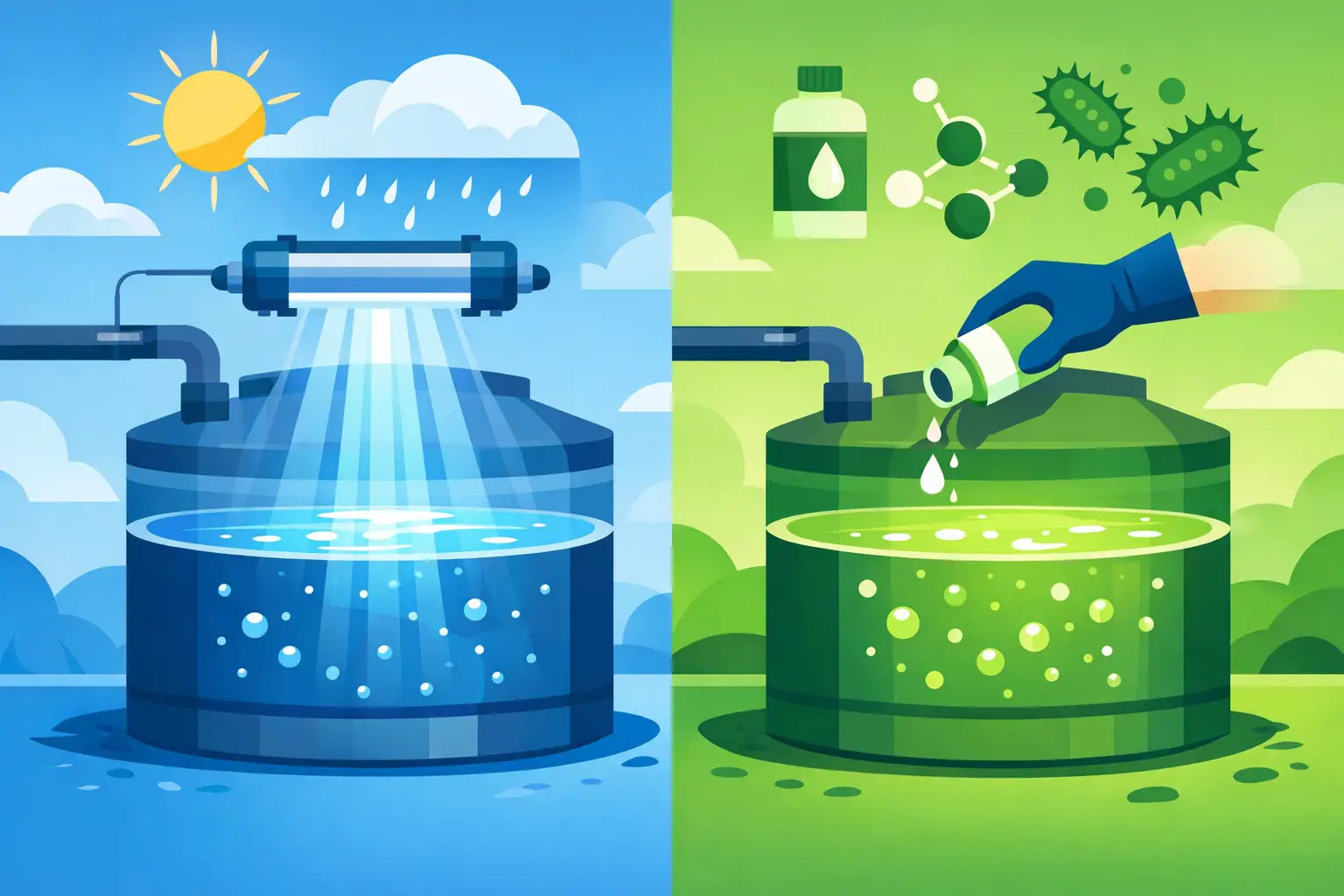
UV sterilisation treats water as it passes through a chamber. A UV lamp exposes bacteria, viruses and protozoa to ultraviolet light, preventing them from reproducing. It does not add anything to the water, change its taste or leave a chemical residual.
Chlorine is a chemical disinfectant added to water. Given the correct dose and contact time, it kills or inactivates many disease-causing organisms. Unlike UV, chlorine leaves a residual in the tank or pipework for a period of time, providing ongoing protection after treatment.
That difference matters. UV is a point-of-use or point-of-entry treatment barrier, typically installed after filtration before water reaches household taps. Chlorine treats the stored water itself and can continue working through parts of the plumbing system. Neither approach can compensate for a poorly maintained tank, dirty roof catchment or inadequate pre-filtration.
When UV treatment is the better fit
UV systems are often the preferred choice for households that want treated rainwater without the taste or smell associated with chlorine. They are particularly useful where water is drawn continuously from a tank through a pump and supplied to the home.
A correctly sized UV unit can provide immediate treatment as water flows through it. There is no waiting period for chemical contact time and no need to calculate a dose every time the tank is topped up. This makes UV a straightforward option for families using rainwater every day.
However, UV only works effectively when the water is clear enough for light to penetrate it. Sediment, tannins, cloudiness and organic matter can shield microorganisms from the UV light. A sediment filter ahead of the UV unit is therefore essential, and the filter rating needs to suit the equipment and the quality of the incoming water.
UV equipment also relies on power and routine maintenance. The lamp must be replaced at the manufacturer’s recommended interval, commonly around every 12 months, even if it still appears to be operating. The protective quartz sleeve requires cleaning because mineral scale or film can reduce UV transmission. If the power is off, the lamp fails or water bypasses the unit, there is no disinfection occurring.
For an occupied home with reliable power, clean pre-filtered water and regular servicing, UV is a strong long-term solution. It is also well suited to properties where the tank water is generally good quality but needs a final microbiological barrier before use indoors.
UV does not clean the tank
A common misunderstanding is that a UV unit treats the entire tank. It does not. It treats only the water passing through the chamber. Sediment and contamination can still build up in the tank, and biofilm can still develop in neglected pipework or fittings.
Good catchment protection remains necessary: fit gutter guards where appropriate, use a first-flush diverter, maintain insect-proof screens, prevent vermin entry and keep the tank lid secure. Periodic tank inspection and cleaning are still part of protecting water quality.
When chlorine is the better fit
Chlorine is often used when a tank has been contaminated, after cleaning or repairs, or when stored water needs disinfection throughout the tank rather than only at the outlet. It can be a practical option for rural properties, seasonal homes and systems where water may sit for extended periods.
Because chlorine leaves a residual, it can provide protection beyond the treatment point. This is useful where pipework is extensive, where multiple outlets are supplied, or where there is concern about contamination entering after the tank. It can also be used as a shock treatment following an event such as a dead animal in a gutter or tank, floodwater exposure, vermin access or significant organic build-up.
The trade-off is that chlorine dosing must be done correctly. Too little may not disinfect effectively. Too much can cause an unpleasant taste and odour, and it may be unsuitable for some uses until the level drops. The required amount depends on tank volume, water condition, chlorine strength and the intended treatment outcome. Chlorine is consumed by dirt, algae and organic material, so a dose that works in a clean tank may not perform the same way in a dirty one.
For that reason, chlorination works best after physical issues have been addressed. Remove debris, clean the tank if required, inspect inlets and screens, and deal with sediment rather than expecting chemicals to solve every water-quality problem.
Chlorine needs contact time and testing
Chlorine is not instant treatment. Water needs sufficient contact time for the disinfectant to work, especially if it is cold, cloudy or carrying a high organic load. If drinking-water quality is the goal, use an appropriate test method to check free chlorine residual rather than relying on smell alone.
Always follow product directions and relevant Australian health guidance. Do not mix chemicals, and do not assume that household bleach is automatically suitable for tank treatment. Products can contain fragrances, thickeners or additives that do not belong in drinking water. When in doubt, seek advice on a water-treatment product intended for potable water applications.
Can UV and chlorine be used together?
Yes. In some systems, combining treatment methods provides a more dependable result than choosing only one. Chlorination can be used to disinfect a tank after contamination or maintenance, while filtration and UV provide ongoing treatment for water entering the house.
This approach is useful when the water source has variable quality. For example, a rural home may collect rainwater from a large roof area, store it for months, then use it for all household supply. Keeping the tank and catchment maintained, responding to contamination with appropriate chlorination, and fitting sediment filtration plus UV at the house creates several barriers rather than relying on a single device.
The system still needs to be designed properly. Carbon filters can reduce chlorine taste and odour, but they may also remove chlorine residual. UV units need adequate flow control and pre-filtration. Pumps, pressure tanks, filters and treatment equipment should be sized for the household’s peak demand, not just the tank outlet size.
Choosing the right treatment for your property
The right decision depends on how you use the water and what risks exist at the source. A small holiday cabin with intermittent use has different needs from a full-time family home, dairy shed, farm accommodation or small commercial site.
Start by considering whether tank water is used for drinking and food preparation, whether children, older people or visitors rely on it, how often the tank is inspected, and whether the roof catchment is exposed to trees, birds or dust. Also consider power reliability, the quality of the stored water, plumbing layout and whether you want a chemical residual in the system.
If you want a final treatment barrier with no taste change, UV with proper filtration is usually the practical choice. If the tank itself needs disinfection or contamination has occurred, chlorine may be required. Where water quality is inconsistent or household supply is critical, using both at different stages can offer greater protection.
Water testing is worthwhile when water is used for drinking, particularly if there has been contamination, illness concerns, a change in taste or odour, or a long period without maintenance. A test can identify whether the issue is microbiological, sediment-related, chemical or linked to plumbing, allowing treatment to be selected on evidence rather than guesswork.
North Coast Water Tanks can assist property owners in matching tank filtration, pumps and UV equipment to the way their water system operates. The aim is not to add unnecessary components, but to build a dependable system that can be maintained without fuss.
A clean roof, screened tank, well-maintained pump and correctly serviced treatment unit will do more for your water quality than any single product alone. Choose UV, chlorine or a combination based on your actual water risks, then keep the whole system working as intended.