


A bore pump comparison should start with the job the pump must do, not the biggest motor or the lowest price. A pump that works well for a house tank may be under-sized for stock water, while a high-flow agricultural pump can be unnecessarily costly to buy and run for a small domestic bore.
The right choice depends on your bore depth, standing water level, required flow, pressure needs, pipework, power supply and water quality. Getting these details right before purchase helps avoid weak pressure, frequent cycling, premature pump wear and expensive changes after installation.
Start with the water demand
First, work out how much water needs to be delivered and when. Flow rate is generally measured in litres per minute or litres per hour. Pressure is measured in kilopascals, bar or metres of head. These are related, but they are not the same thing.
A household with a few taps, toilets, a washing machine and garden irrigation may need steady pressure rather than very high volume. A farm may need larger volumes for troughs, irrigation zones, wash-down areas or transfer between tanks. Commercial sites can have more demanding peak loads, particularly where multiple outlets operate at once.
Do not size a bore pump based on total daily water use alone. A property may only use a modest volume each day but still require strong flow during the morning household peak or when several irrigation stations are running. Conversely, a large storage tank can reduce the need for a high-flow pump if water is transferred gradually over a longer period.
Bore pump comparison: the main pump types
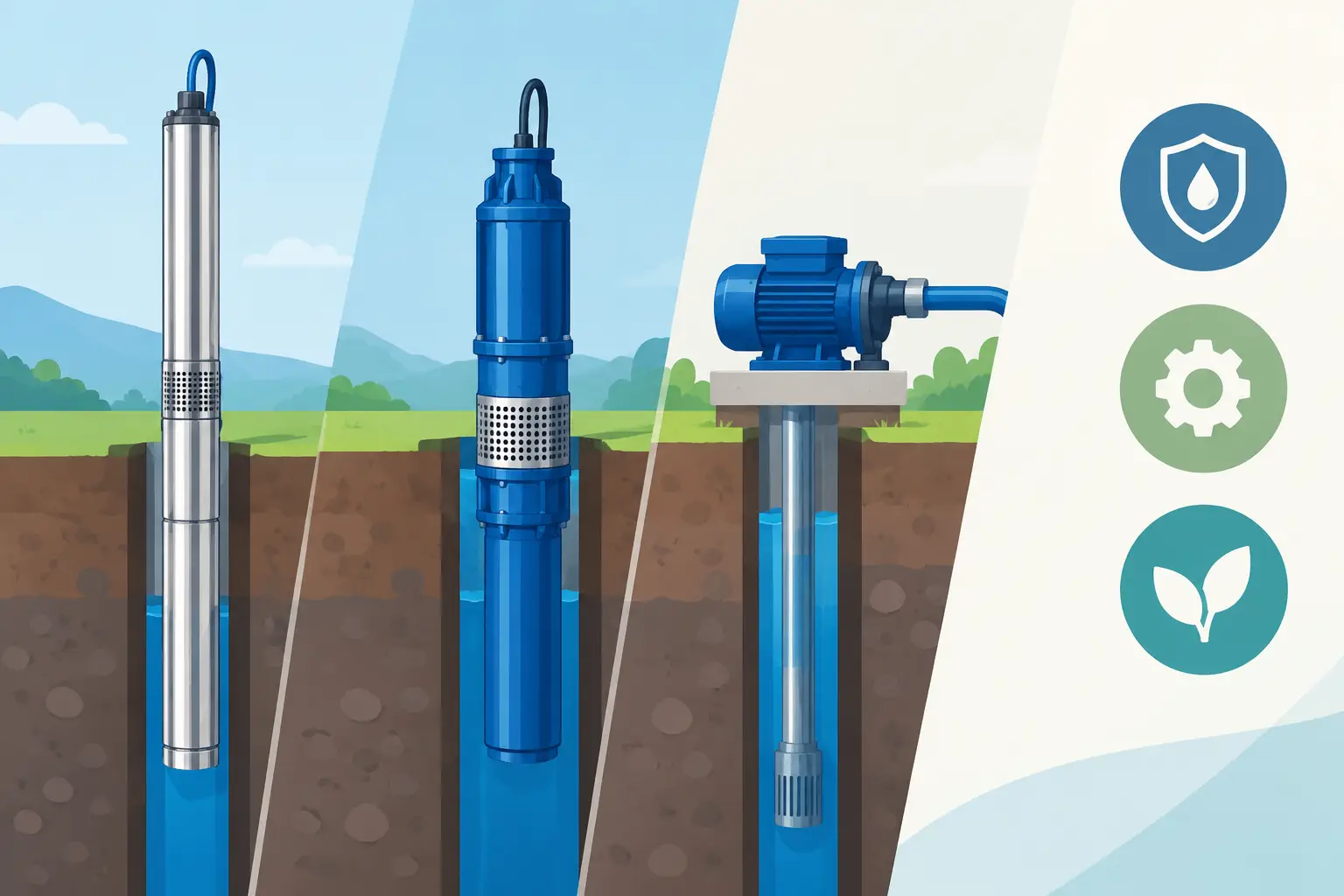
Most permanent bores use a submersible bore pump. It sits below the water level inside the bore casing and pushes water upward through the delivery pipe. This arrangement is generally efficient for deep bores because the pump does not have to draw water up from the surface.
Submersible multistage bore pumps
A multistage submersible pump is the common choice for domestic, rural and agricultural bores. Multiple impellers build pressure progressively, making these pumps suitable for lifting water from depth and supplying tanks, homes or irrigation systems.
They are available in different diameters, commonly suited to 3-inch, 4-inch and larger bores. A narrow bore requires a pump that physically fits with adequate clearance for installation and cooling. The motor and cable must also be selected for the application, particularly where the pump will operate for extended periods.
For most properties, this is the most practical category to compare. The real difference between models is usually not simply motor size. It is the pump curve – the relationship between flow and head – along with construction quality, sand handling ability, controls and service support.
Surface-mounted jet pumps
Jet pumps are positioned above ground and draw water from a bore or well. They can suit shallow water sources, but their practical suction depth is limited. As depth increases, performance drops and priming becomes more critical.
For a properly drilled, deeper bore, a submersible pump is usually the better option. Jet pumps may still have a place where the water level is shallow, access inside the bore is limited, or the pump needs to remain at the surface for a particular site arrangement.
Solar bore pumps
Solar pumping can be a sensible option for remote stock water, trough supply and tank filling where grid power is unavailable or expensive to extend. A solar system is normally designed to pump when sunlight is available, with water stored in tanks for use at other times.
The trade-off is that solar output changes with season, cloud cover and panel orientation. The system needs to be matched carefully to the bore yield, lift and storage capacity. For critical domestic supply, many owners prefer mains power, generator backup or a hybrid arrangement.
| Pump option | Best suited to | Main consideration | |—|—|—| | Submersible multistage pump | Domestic, rural and irrigation bores | Must be matched to depth, flow and bore diameter | | Surface jet pump | Shallow bores and wells | Limited suction lift and requires reliable priming | | Solar bore pump | Remote tank filling and stock water | Requires adequate solar access and storage |
Calculate total head, not just bore depth
One of the most common sizing errors is treating the drilled depth of the bore as the pumping depth. What matters is the dynamic water level – the water level while the pump is operating – plus the vertical lift above ground and the pressure required at the outlet.
For example, water may sit 25 metres below ground at rest but fall to 40 metres while pumping. If the tank inlet is another 8 metres above ground, and the system needs pressure equivalent to 25 metres of head, the pump must perform at around 73 metres of head before pipe friction is added.
Friction losses can be significant on long runs, undersized pipe and systems with many bends, valves and filters. A 32 mm line may be adequate for a modest domestic flow but restrictive for higher-volume irrigation. Larger pipework costs more initially, yet it can reduce friction, improve delivery and lower pumping energy over time.
A reliable pump selection uses the manufacturer’s performance curve at your calculated duty point. The aim is not to select the pump with the highest maximum head or maximum flow. It is to select a pump that produces the required flow at the required total head, with sensible operating margin.
Match the pump to bore yield
The bore itself has a sustainable yield. This is the rate at which it can provide water without drawing down excessively or running dry. Installing a pump capable of 100 litres per minute does not mean the bore can produce that volume.
If the pump outpaces the bore, the water level can fall below the pump intake. The result may be loss of supply, overheating, dry-running damage or increased sand movement. This is particularly relevant on older bores and in dry periods when groundwater levels may be lower.
A pump test provides the clearest information. It should identify static water level, pumping water level, recovery rate and sustainable flow. Where yield is limited, it is often better to pump steadily into a storage tank and use a separate pressure pump for the house, sheds or irrigation. This approach gives the bore time to recover while still providing reliable pressure where it is needed.
Water quality changes the pump decision
Clear water does not always mean easy water. Bore water can contain fine sand, iron, manganese, dissolved minerals, salt or other contaminants. These conditions affect both pump life and the wider water system.
Sand is especially hard on impellers, bearings and valves. A pump designed for limited sand handling may fail early if it is used in a bore producing abrasive material. Positioning also matters. The pump should generally sit above the bottom of the bore to reduce the chance of drawing sediment, while remaining sufficiently submerged during pumping.
Iron and mineral content can stain fixtures, block filters and foul pressure switches or irrigation equipment. If water is being used for household supply, arrange water testing before choosing filtration. The bore pump and treatment system should be considered together, as some filters require a minimum flow or pressure to operate correctly.
Controls, protection and power supply
A bore pump is only as dependable as its controls and protection. At a minimum, consider dry-run protection, overload protection and a suitable controller or pressure switch. Dry-run protection can shut the system down when water levels fall too low or when abnormal operating conditions are detected.
For a tank-transfer arrangement, float switches prevent overflow and can stop the pump when the tank reaches the required level. For direct pressure supply, a pressure controller or pressure tank helps manage start and stop cycles. Excessive cycling is hard on motors and can be a sign that the pressure tank is incorrectly sized, the settings are wrong or there is a leak.
Check the available power before selecting the pump. Smaller domestic systems may operate on single-phase power, while larger pumps often require three-phase supply. Long cable runs need correct cable sizing to avoid voltage drop, which can cause poor performance and motor damage. All electrical work should be completed by a qualified electrician.
Look beyond the purchase price
A cheaper pump can become the expensive option if it is difficult to service, poorly matched to the duty, or lacks suitable protection. Compare the full installation requirement: pump, motor, cable, drop pipe, fittings, non-return valve, controller, pressure equipment and filtration where required.
Quality Assurance matters because a bore pump is difficult to access once installed. Choosing equipment suited to Australian conditions, backed by clear technical data and local support, can make future maintenance far more straightforward. For rural and coastal properties, availability of replacement parts and practical advice is often worth more than a small upfront saving.
North Coast Water Tanks can help property owners assess bore pump requirements alongside tank storage, filtration and pressure systems, so the complete water setup works as intended.
Before committing to a pump, confirm the bore diameter, dynamic water level, sustainable yield, delivery distance, pipe size, desired flow, pressure requirement, power supply and water quality. With those figures in hand, the right pump becomes a practical engineering choice rather than a guess made from a catalogue page.