


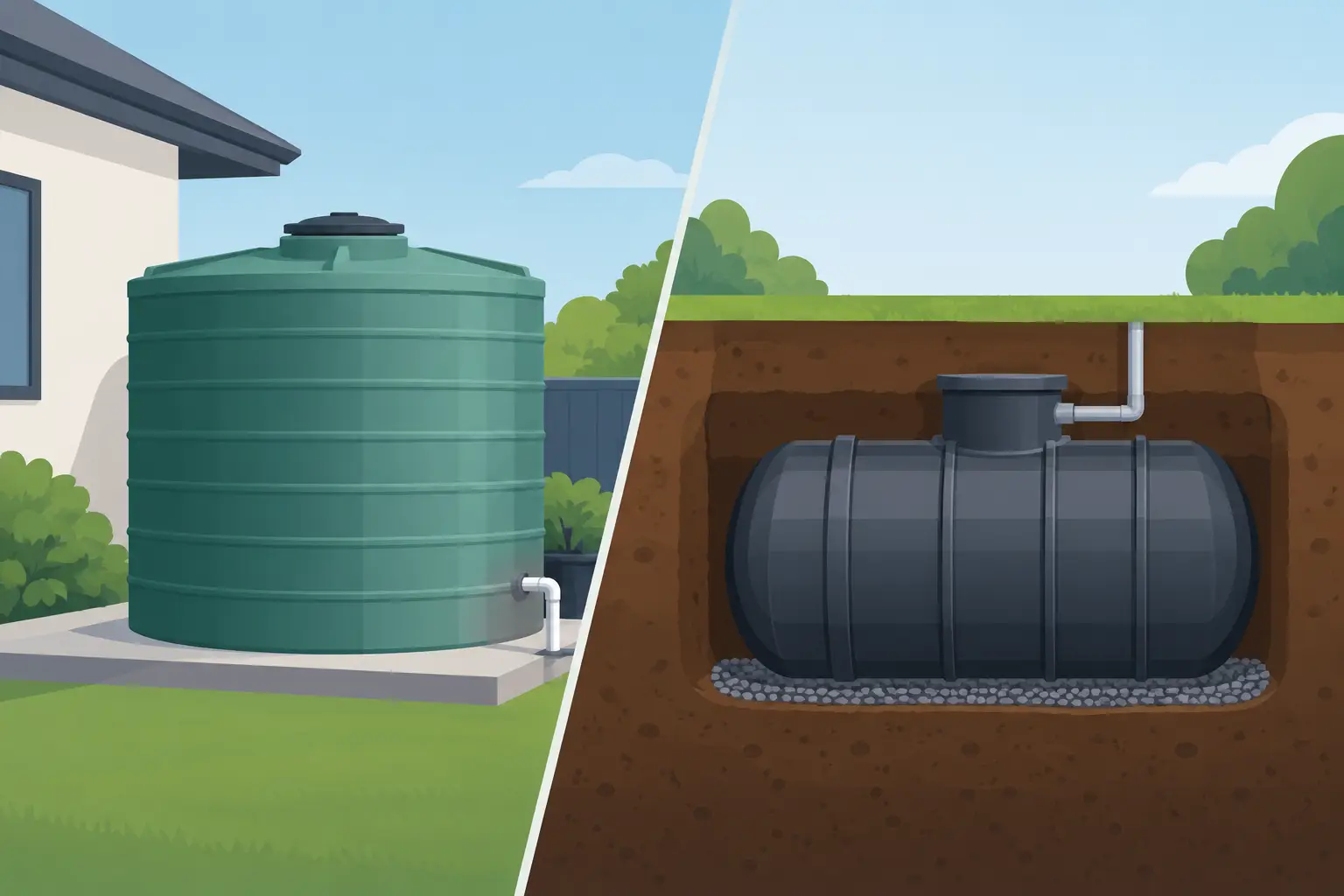
A tank location affects far more than how your property looks. When comparing above ground vs underground tanks, the right choice comes down to available space, site access, budget, water demand and how easily you need to inspect and maintain the system. For many Australian homes, farms and commercial sites, an above-ground tank is the most practical option. In tight urban blocks or projects where appearance matters, an underground tank may be worth the added planning and cost.
The best result is not simply choosing the tank with the largest capacity. It is selecting a complete water storage system that suits your roof catchment, pump requirements, ground conditions and long-term maintenance plan.
Above ground vs underground tanks: the main difference
Above-ground tanks sit on a prepared base where they remain visible and accessible. They are commonly made from food-grade polyethylene, steel or Aquaplate materials, with round, slimline and modular shapes available to suit different sites. Installation is generally straightforward where delivery access is available, and the tank can be inspected without excavation.
Underground tanks are installed below ground level, usually with only a lid, access cover or pump point visible at the surface. They can preserve valuable yard space and suit properties with planning, visual or design restrictions. However, they require excavation, engineered installation and careful consideration of groundwater, soil movement and vehicle loads.
Neither option is automatically better. A rural acreage with plenty of open space has different priorities from a suburban home with a narrow side passage or a business site with limited room for visible storage.
Why above-ground tanks suit most properties
For rainwater harvesting, above-ground tanks are often the most cost-effective and serviceable choice. Water can flow from roof gutters into the tank by gravity, and a pump can then deliver water to garden taps, toilets, washing machines, stock troughs or household fixtures where appropriate filtration is installed.
The major benefit is access. You can see the tank body, check the inlet screen, inspect overflow arrangements, monitor water levels and arrange cleaning or repairs without digging. If a pump, valve, fitting or liner needs attention, the work is usually faster and less expensive than it would be with an underground installation.
Above-ground tanks also offer flexibility. A property owner may begin with one tank and add another later as water demand grows. Linked tanks can increase storage capacity without replacing the original tank, provided the site base, plumbing and overflow system are designed correctly.
A properly prepared base is essential. Poly tanks require a level, stable and fully supported base, typically compacted sand, crusher dust or a suitable concrete slab. Steel tanks also need a sound foundation and professional attention to site drainage. A poor base can lead to settlement, distortion or stress on fittings, regardless of tank quality.
Considerations for visible tanks
The obvious trade-off is appearance and space. A large round tank can dominate a small yard, while slimline tanks provide a lower-profile alternative along a fence line or beside a house. Tank colour can help the unit sit more comfortably within the property, but it will still be visible.
Above-ground tanks can also be exposed to impact from vehicles, machinery and falling branches. Positioning matters. Keep the tank clear of driveways, allow access for maintenance, and avoid locations where roof runoff cannot be directed efficiently into the inlet.
In bushfire-prone areas, tank placement, fittings and access for firefighting water may need to meet specific local requirements. Check the applicable building, planning and fire provisions before installation rather than making assumptions based on a neighbouring property.
When an underground tank makes sense
Underground tanks are a practical option when surface space is limited or a property owner wants to retain open areas for parking, landscaping, access or recreation. They are often considered for new builds, architect-designed homes, commercial premises and compact suburban sites where a visible tank is not desirable.
Because the tank is protected from direct sunlight, underground storage can reduce exposure to UV and limit water temperature fluctuations. This does not remove the need for good rainwater management. Leaf screens, first-flush devices, sealed access covers, appropriate filtration and regular maintenance are still needed to protect water quality.
An underground system can be particularly effective where roof water needs to be captured but there is no practical location for a large tank at ground level. With the right design, water can be stored out of sight and pumped to the house or irrigation system when required.
The cost and site-work reality
Underground tanks generally cost more to install than an equivalent above-ground tank. The tank itself is only part of the project. Excavation, soil removal, bedding, drainage, plumbing, electrical work, pump selection and surface reinstatement all need to be allowed for.
Soil and water conditions are critical. Reactive clay, unstable fill, rock, a high water table or poor drainage can significantly change the installation method and cost. Groundwater can place upward pressure on an empty or partially empty tank, while heavy rainfall around the excavation can create drainage issues if the site has not been designed correctly.
Traffic loading is another important factor. An underground tank must not be placed beneath a driveway, parking area or machinery route unless it is specifically designed and installed for that load. A standard underground tank is not automatically suitable for vehicles passing overhead.
Access also deserves careful thought. Although underground tanks save visible space, they still require safe access for inspection, cleaning and any future repairs. Covers should remain accessible after landscaping is complete, and pumps or filtration equipment should be located where technicians can reach them safely.
Pumps, filtration and usable water supply
Tank location changes the equipment requirements. An above-ground tank may use a surface-mounted pump positioned close to the outlet, with suction and delivery lines arranged to minimise pressure loss. An underground tank commonly uses a submersible pump or a suitable pressure system designed to lift water efficiently from below ground level.
The pump should be selected for the required flow and pressure, not only tank size. A household supplying toilets, laundry, garden taps and irrigation has different demand from a farm trough system or a small commercial wash-down point. Pipe diameter, elevation changes, distance to the building and the number of outlets all affect pump performance.
For water intended for household use, filtration should match the use of the water and the quality of the catchment. Sediment filtration can protect pumps and appliances, while carbon filtration may improve taste and odour. UV sterilisation may be appropriate where treated rainwater is used for drinking, subject to a properly designed system and ongoing lamp and filter maintenance.
A clean tank alone does not guarantee clean water at the tap. Gutter maintenance, leaf protection, inlet screens, first-flush diversion and correctly maintained filters all work together.
Approvals, setbacks and installation planning
Before ordering a tank, check local council requirements, planning controls, building rules and any estate covenants that apply to your property. Requirements can vary between councils and may cover tank size, location, overflow management, setbacks, stormwater connections and structural works.
For underground projects, engage suitable contractors early. They can assess excavation access, services such as electrical and water lines, soil conditions and the location of existing drainage. Hitting an unmarked service during excavation is an expensive problem that good planning can avoid.
For above-ground installations, measure delivery access as carefully as the final tank location. Gates, corners, overhead wires, trees, slopes and narrow driveways can all affect whether a large tank can be delivered in one piece. In some cases, a slimline tank, multiple smaller tanks or a steel tank assembled on site may be the better solution.
Making the practical choice
Choose an above-ground tank when you have usable space, want lower installation costs and value straightforward inspection and maintenance. It is usually the sensible option for rural properties, acreage homes, farm water systems and many suburban rainwater harvesting projects.
Consider an underground tank when surface area is restricted, visual impact is a major concern or the project is being planned alongside a new build or substantial landscaping work. Be prepared to invest in proper excavation, drainage, engineering and access provisions.
North Coast Water Tanks can help property owners assess storage capacity, tank type, pumps, filtration and the accessories needed to make the whole system work reliably. A well-planned tank installation should make water easier to manage for years, not create an access or maintenance problem after the landscaping is finished.