


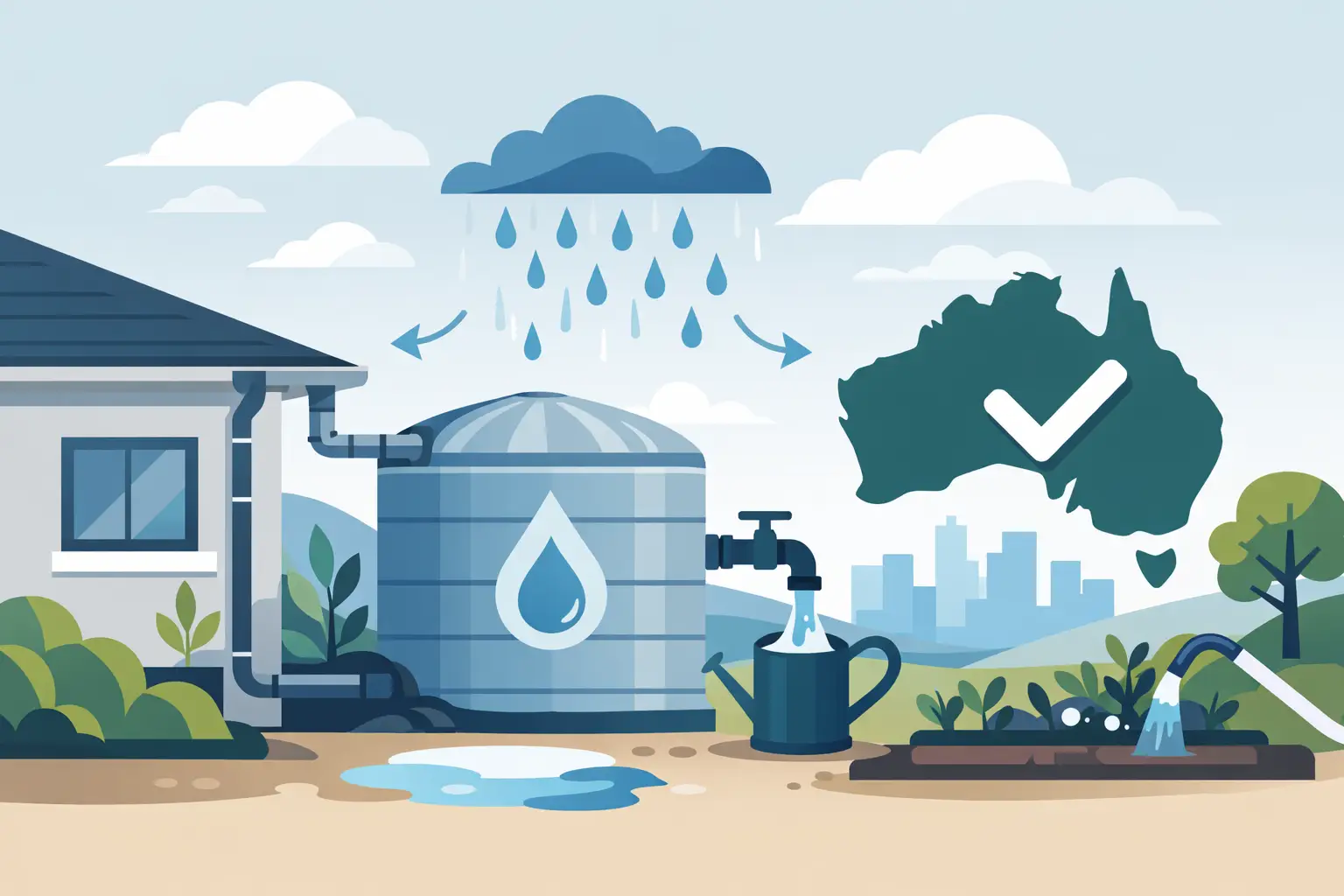
A rainwater tank can reduce reliance on mains supply, provide useful reserve water during dry periods and make better use of the roof area you already own. But knowing how to harvest rainwater legally means treating the tank, plumbing and intended water use as one system. In Australia, collecting rainwater is generally permitted, yet planning controls, plumbing rules and health requirements can still apply to the installation.
The exact requirements depend on your state or territory, local council, property type and whether the water will be used outdoors, inside the home, for livestock or in a business. Getting those details right before the tank arrives avoids costly relocation, plumbing alterations or compliance issues later.
Start with your council and state requirements
For most homes and rural properties, installing a rainwater tank does not require a special licence to collect rain falling on your roof. The legal side usually relates to where the tank sits, how it is connected and what the stored water supplies.
Your local council is the first practical check. Ask whether your proposed tank needs development approval, a building approval or can proceed as exempt development. Smaller above-ground tanks may be straightforward, but requirements can change where a tank is large, elevated, close to a boundary, installed in a heritage area or located within a flood-prone or bushfire-prone zone.
Also check state plumbing requirements and any local water authority conditions. These rules are particularly relevant when rainwater will feed toilets, laundries, hot-water systems or taps inside the building. A qualified plumber can confirm the approved connection method for your location and whether a backflow prevention device, specific pipework or labelling is required.
Do not assume that a neighbour’s installation meets current rules. Tank standards, council planning controls and plumbing requirements can vary between local government areas and may have changed since an older system was installed.
Choose a legal and practical tank location
Tank placement is where compliance and long-term performance meet. A tank needs a stable, level base designed for its full weight. Water weighs one kilogram per litre, so a 22,500-litre tank holds more than 22 tonnes when full. An inadequate base can cause uneven settling, stress the tank wall and create drainage problems around the property.
Set the tank where it can receive downpipes efficiently without obstructing access, stormwater flow, driveways or essential services. Keep clear of underground power, sewer and water lines, and consider access for delivery, maintenance and tank cleaning. A large tank that cannot be safely reached by service equipment becomes harder to maintain over time.
Boundary setbacks, height limits and visibility from the street may also be controlled by council rules. These issues are more common with elevated tanks, steel tanks on stands and commercial installations. If you are planning an underground tank, expect additional requirements around excavation, structural loading, child safety and access covers.
The overflow needs just as much attention as the inlet. It must direct excess water to an approved drainage point without flooding neighbouring land, undermining the tank base or creating erosion. In some locations, connecting overflow into stormwater infrastructure has specific conditions. A licensed professional or council officer can clarify what applies to your block.
Keep rainwater plumbing separate and compliant
A rainwater system can be as simple as a tank with a tap for the garden, or as involved as a pump supplying multiple fixtures. The moment you connect rainwater to household plumbing, compliance becomes more critical.
Rainwater pipework must not be able to contaminate the mains water supply. Cross-connections between tank water and drinking water are a serious health risk and are not acceptable. Where both supplies serve the same property, the system may need appropriate backflow prevention, air gaps, clearly identified pipework and a compliant changeover arrangement.
For internal use, engage a licensed plumber familiar with rainwater systems. They can install the pump, pressure controller, first-flush device, filters and mains backup arrangement correctly. This is not simply a matter of making the water flow. The installation needs to protect the public water network and allow safe, reliable operation when the tank runs low.
If rainwater is only used for gardens, washing vehicles or stock troughs, the plumbing arrangement is usually simpler. Even then, use suitable fittings, protect electrical connections at the pump and ensure children cannot access unsafe tank openings.
Match filtration to the way you will use the water
Rainwater quality starts at the roof. Leaves, dust, bird droppings and airborne debris can enter the system, especially after dry weather or storms. A clean roof catchment, gutter guard, leaf strainer and first-flush diverter reduce the load entering the tank.
For garden use, basic screening and sensible maintenance may be enough. For household use, particularly drinking, cooking and bathing, a more complete treatment approach is often appropriate. Sediment filtration removes fine particles, while carbon filtration can improve taste and reduce some contaminants. UV sterilisation is commonly used as an additional barrier against microorganisms, but it works properly only when the water is already adequately filtered and the unit is maintained.
There is no single filtration package that suits every property. A family using tank water as its main supply needs a different system from a weekend cabin, dairy shed or acreage home connected to town water. Roof material, local air quality, storage time, tank capacity and the intended use all affect the right setup.
If rainwater will be supplied to customers, employees, tenants or the public, additional health and business obligations may apply. Food businesses, accommodation providers and commercial sites should seek advice from their local council or relevant health authority before relying on tank water for potable use.
Maintain the system to stay safe and functional
Legal installation is not a one-off task. A neglected tank can become a hygiene problem, a mosquito breeding site or a source of pump failure. Regular maintenance protects your water quality and extends the life of the equipment.
Check gutters and inlet screens after heavy leaf fall or storms. Ensure every opening is covered with insect-proof mesh, including overflow points. Inspect the tank for cracks, damaged lids, loose fittings and evidence of vermin entry. Keep the area around the tank clear enough to inspect connections and detect leaks early.
Filters need replacement on the schedule recommended for the system and according to actual water quality. UV lamps and sleeves also require routine servicing. If the water has an unusual smell, colour or taste, stop using it for drinking until the cause has been identified and rectified.
Tank cleaning is occasionally necessary, particularly where sediment has built up or contamination has occurred. The frequency depends on the roof catchment, pre-filtration, local conditions and how heavily the water is used. Professional cleaning and inspection can be worthwhile for large tanks, difficult-access sites and household drinking-water systems.
Plan capacity around demand, not just roof size
A legal system should also be fit for purpose. A tank that overflows constantly provides less value than it could, while an undersized tank may run dry before the next rainfall. Start by estimating roof catchment area, local rainfall patterns and likely demand.
For a household, demand may include toilets, laundry, garden use and drinking water. On rural properties, factor in livestock, wash-down needs, fire reserve requirements and seasonal demand. Some councils, insurers or bushfire planning conditions may have separate expectations for dedicated firefighting water storage and accessible fittings.
Tank material matters too. Poly tanks are a practical option for many residential and rural applications because they are durable, corrosion-resistant and available in a wide range of capacities. Steel or Aquaplate tanks can suit larger storage requirements or sites where their form and capacity are preferred. In every case, select a food-grade tank where water may be used for household supply and ensure the product is designed for Australian conditions.
North Coast Water Tanks can assist property owners with selecting compatible tanks, pumps, filtration and accessories, so the system is planned as a complete installation rather than a collection of mismatched parts.
How to harvest rainwater legally without costly rework
The most reliable approach is to confirm approvals before ordering, establish the tank location and base, then have plumbing and electrical work completed by appropriately qualified trades. Keep product information, installation records and any council approvals with your property documents. They are useful for future maintenance, insurance questions and property sales.
A well-planned rainwater system is practical infrastructure. When the tank is correctly located, safely plumbed and maintained for its intended use, it can provide dependable water through changing seasons without creating avoidable compliance problems.