


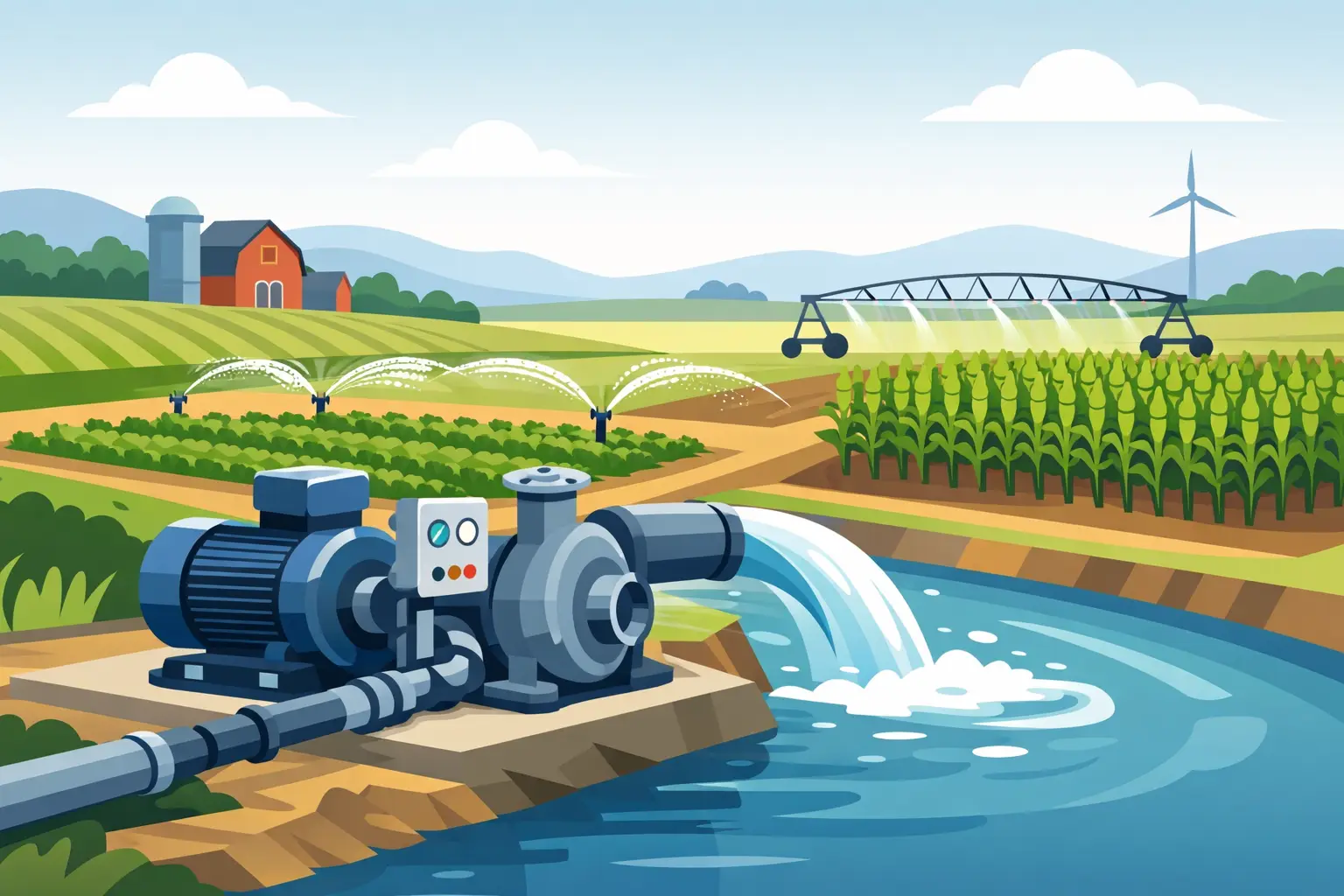
A farm irrigation pump system usually gets attention only when pressure drops, sprinklers miss a run, or a transfer line takes too long to fill a tank. By then, the real issue is often bigger than the pump itself. On farms, irrigation performance depends on how well the pump, pipework, storage, filtration and controls work together under local conditions.
That is why pump selection should never be treated as a simple horsepower decision. A system that looks adequate on paper can still struggle if the suction line is too long, the pipe size is undersized, or the water source varies through the season. Getting it right from the start saves water, power, time and avoidable wear on equipment.
What a farm irrigation pump system needs to do
At its most basic, the job is straightforward. The pump has to move water from a source to where it is needed, at the right flow and pressure, for the right length of time. In practice, those three points – source, demand and duty cycle – shape nearly every equipment decision.
A small horticulture block running drip lines has very different requirements from a grazing property filling troughs, shifting water between tanks and supplying a travelling irrigator. Some properties need consistent low-flow delivery over long periods. Others need high-volume transfer in shorter windows. If the system has to do both, that needs to be accounted for early rather than patched in later with workarounds.
The best results come from treating irrigation as a full water infrastructure job, not a standalone pump purchase. Storage capacity, tank location, intake protection, filtration and control all affect how well the pump performs across the season.
Start with the water source
Before looking at pump models, check where the water is coming from and how reliable that source is. Water drawn from a river, creek, bore, dam or tank behaves differently, and each source creates its own design constraints.
Dam and creek water often carry sediment, organic matter and seasonal variation. That can affect impeller wear, suction reliability and filter loading. Bore water may be cleaner in terms of solids but can introduce mineral content or flow limits. Tank-fed systems are usually more stable, but only if storage volume is adequate and the tank outlet, valves and pipework are sized correctly.
Suction lift matters as well. If the pump has to pull water uphill from a low source, the practical performance can fall away quickly. In many cases, reducing suction issues by moving the pump, changing the layout or using an appropriate transfer arrangement delivers better reliability than simply buying a larger unit.
Water quality changes the pump setup
Water quality does not just affect filtration. It influences pump type, seal life, maintenance frequency and how often strainers need cleaning. If your source water carries leaf matter, silt or algae, inlet protection becomes part of the system, not an optional extra.
That is especially true where irrigation downtime has a direct effect on crop health or pasture management. A blocked line or damaged pump can cost far more than the price difference between a basic setup and one built with the right protection.
Flow and pressure must match the application
This is where many irrigation issues begin. A pump can provide strong pressure but not enough flow, or plenty of flow without enough pressure to operate the irrigation method properly. Either way, the result is poor coverage, uneven delivery and wasted run time.
Drip irrigation generally needs lower flow and controlled pressure. Sprinklers and spray systems often need higher pressure to perform evenly. Long pipeline runs, elevation changes and multiple outlets running at once add further demand. If you size the pump only around the irrigation head and ignore friction losses through pipe and fittings, the real-world result will disappoint.
A proper assessment looks at total dynamic head, expected litres per minute, pipe diameter, vertical lift and the operating pattern across the property. If future expansion is likely, it is worth allowing some capacity now rather than replacing major components later.
Oversizing is not always safer
Many landholders assume a bigger pump gives more security. Sometimes it does, but not always. An oversized pump can short cycle, draw unnecessary power, create pressure problems and wear components faster. It may also force upgrades in pipework or controls that were never budgeted for.
The better approach is to select a pump that matches actual operating conditions, then support it with the right pressure control, storage arrangement and pipe sizing. That gives steadier performance and usually lowers whole-of-system costs over time.
Choosing the right pump type for farm irrigation
Different pump styles suit different jobs. Surface pumps are common where water is readily accessible and suction conditions are manageable. They are often used for tank supply, dam transfer and general irrigation duties where access for servicing is important.
Submersible pumps suit bores, deeper water sources and some tank applications where suction lift would otherwise become a limitation. They can be an efficient option, though installation and retrieval need to be considered.
Multistage pumps are often chosen where higher pressure is required, particularly for irrigation zones with long runs or elevation change. Transfer pumps are useful where the main need is moving volume between storages rather than driving irrigation hardware directly.
The right choice depends on more than the label on the box. It depends on whether the system is feeding sprinklers, drip zones, troughs, header tanks or a mix of all of them. On many properties, the most reliable outcome comes from separating transfer duties from irrigation duties instead of expecting one pump to do every job equally well.
Farm irrigation pump system design is more than the pump
A farm irrigation pump system performs only as well as the layout around it. Pipe diameter is a common weak point. Undersized pipe increases friction loss, reduces usable pressure and forces the pump to work harder for less result. The same applies to too many sharp bends, poor valve placement and makeshift joins added over time.
Storage also plays a major role. Tanks can buffer demand, reduce stress on the source and give you more control over irrigation timing. If power tariffs, source limits or seasonal pumping windows matter on your property, a good storage strategy can improve efficiency just as much as a pump upgrade.
Controls are another area worth getting right. Pressure switches, float switches, variable speed control and dry-run protection all help protect equipment and stabilise operation. For remote or lightly attended sites, these features are often worth the investment because they reduce nuisance failures and prevent costly damage.
Filtration should be sized with the system
Filtration is often added late, but it should be considered from the start. Drip and micro irrigation are especially sensitive to debris and sediment. Even larger sprinkler systems benefit from proper screening where source water quality is inconsistent.
The filter has to suit both the water quality and the required flow. Too small, and it becomes a restriction. Too coarse, and downstream equipment remains exposed. A balanced setup keeps pressure loss manageable while protecting emitters, valves and pump components.
Reliability, maintenance and running costs
On a working farm, reliability is not a bonus feature. It is part of the value equation. A cheaper unit that struggles through one season, burns power and needs repeated attention often costs more than a better-specified system with proper support behind it.
Regular maintenance is straightforward when the installation is sensible. Clear access to the pump, valves and filters makes inspections quicker. Checking for leaks, unusual vibration, blocked strainers, worn seals and pressure changes should be part of routine property maintenance, especially during peak irrigation periods.
Power consumption also matters. Efficient pump selection reduces running cost, but so does correct pipe sizing and system layout. If the pump is constantly working against unnecessary restriction, the power bill will show it. In some cases, redesigning the line or adding storage delivers better savings than changing motors alone.
When to upgrade an existing system
A full replacement is not always necessary. Sometimes the pump is sound, but the rest of the setup has outgrown it. Added irrigation zones, longer runs, changed crops or extra storage can all shift the original design beyond its intended duty.
Signs that an upgrade is worth investigating include uneven irrigation, poor pressure at the far end of the line, frequent cycling, repeated blockages, rising power use or a system that only works properly when part of the farm is shut off. These problems usually point to mismatch somewhere in the design, not just general wear.
For many properties, the smartest path is staged improvement. That might mean adding filtration first, correcting pipework bottlenecks, improving tank storage, then selecting a pump that suits the revised layout. It is a practical way to build a dependable system without spending in the wrong area.
Choosing a farm irrigation pump system is really about building confidence in your water supply. When the pump, storage, filtration and layout are matched to the property, irrigation becomes predictable, easier to manage and less vulnerable when conditions turn against you.