


A bore that looks clean in a glass can still stain laundry, block taps, corrode pipework or carry contaminants that make it unsuitable for drinking. The best filters for bore water are not a single off-the-shelf unit. They are a filtration system selected around the actual water quality, daily demand and intended use on your property.
For a garden bore, a basic sediment filter may be enough to protect sprinklers and pumps. For a house, farm accommodation or food-related use, the system often needs several treatment stages. Starting with a water test prevents costly guesswork and helps ensure the equipment is doing the job it was installed to do.
Start With a Bore Water Test
Bore water quality can vary widely between neighbouring properties and can change over time. Seasonal groundwater movement, flooding, nearby land use, ageing bore components and changes to pumping rates may all affect the result. Do not choose a filter based only on a neighbour’s system or on whether the water has a metallic taste.
A comprehensive laboratory test should be arranged before selecting whole-of-house filtration. Ask for analysis relevant to your intended use, including pH, turbidity, total dissolved solids, hardness, iron, manganese, sulphur, nitrate, fluoride and microbiological contamination. In some areas, additional testing for arsenic or other naturally occurring minerals may be appropriate.
The test result tells you whether the main issue is physical particles, dissolved minerals, bacteria or a combination. It also identifies treatment limits. For example, a carbon filter may improve taste and odour, but it will not make highly saline water suitable for drinking. A UV unit can disinfect clear water, but it does not remove sediment, iron, salt or chemicals.
Common Bore Water Problems and the Filters That Suit Them
Most reliable bore water systems use a treatment train, where each stage prepares the water for the next. The right order matters. Putting a fine cartridge before a heavy sediment load, for instance, can mean frequent blockages and poor pressure.
Sediment, sand and cloudy water
Sand, silt and fine sediment are common where a bore produces particles from the aquifer or where pumping disturbs material around the bore screen. These particles wear pump seals, clog irrigation nozzles and shorten the service life of appliances.
For larger particles, a washable spin-down or screen filter is often a practical first stage. It is particularly useful for protecting pumps and irrigation equipment because it can be flushed rather than continually replaced. Where water remains cloudy, a multimedia filter or graded sediment cartridges may be needed. Start with a coarser stage, then move to finer filtration only where required.
Iron and manganese staining
Orange-brown marks in toilets, on concrete and in washing are usually signs of iron. Manganese often creates darker brown or black staining. Both can leave deposits in pipes, hot-water systems and pressure pumps.
Iron and manganese are normally dissolved when the water comes from the bore, so a standard sediment cartridge alone is rarely the answer. Treatment often involves aeration or oxidation followed by a backwashing media filter that captures the oxidised particles. The best media depends on the concentration, pH, flow rate and whether manganese is also present.
These systems need enough flow for backwashing and somewhere safe for the backwash water to drain. That site requirement is easily overlooked, especially on smaller blocks or where drainage must be managed carefully.
Hard water and scale
Hard water contains elevated calcium and magnesium. It is not always a health concern, but it can leave scale on taps, shower screens, kettles and hot-water equipment. Scale also reduces the efficiency of hot-water systems and can restrict valves and pipework over time.
A water softener is the usual treatment where hardness is confirmed as the problem. Softening exchanges hardness minerals for sodium or potassium, so it is worth discussing household health needs, garden use and regeneration water disposal before installation. In some cases, protecting only the hot-water service or selected internal lines is more practical than softening every outlet on the property.
Salty or high-TDS bore water
High total dissolved solids, including sodium and chloride, can make bore water taste salty and may affect gardens, livestock requirements, plumbing and appliances. Conventional sediment filters, carbon cartridges and UV units do not remove dissolved salts.
Reverse osmosis can reduce salts and many dissolved contaminants, but it is generally best used at a dedicated drinking-water tap rather than for an entire house. Whole-of-property desalination requires specialist design, adequate storage, careful pre-treatment and a plan for concentrate disposal. It can be worthwhile where bore water is the only supply, but it should be assessed as a complete water-management project rather than a simple filter purchase.
Bad taste, odour and sulphur smell
A rotten-egg smell commonly points to hydrogen sulphide, although bacteria, organic matter and other conditions can also affect odour. Activated carbon may help with mild taste and odour concerns once particles have been removed. Higher sulphur levels often need oxidation and filtration before carbon polishing.
Carbon has a finite service life. When it is exhausted, performance drops and it can become a maintenance issue if left unchanged. Select cartridge sizes and replacement schedules that suit your household demand rather than choosing the smallest option at the lowest upfront price.
Bacteria and other microorganisms
Untreated bore water should not be assumed safe for drinking simply because it is underground. Contamination can enter through damaged bore caps, surface runoff, nearby animals, flooding, plumbing faults or storage tanks. Regular microbiological testing is sensible for any bore water used in a home, accommodation building or workplace.
UV sterilisation is an effective final barrier for clear, pre-filtered water. It works by exposing microorganisms to ultraviolet light as water passes through the chamber. For UV to work properly, sediment and staining minerals need to be treated first, as cloudy water can shield organisms from the UV dose. The lamp and sleeve also require routine servicing.
Chlorination is another option, particularly for larger storage volumes or systems where a disinfectant residual is required. It needs accurate dosing and contact time, and should be designed to avoid unpleasant taste, corrosion or over-dosing.
A Typical Whole-of-House Bore Water Setup
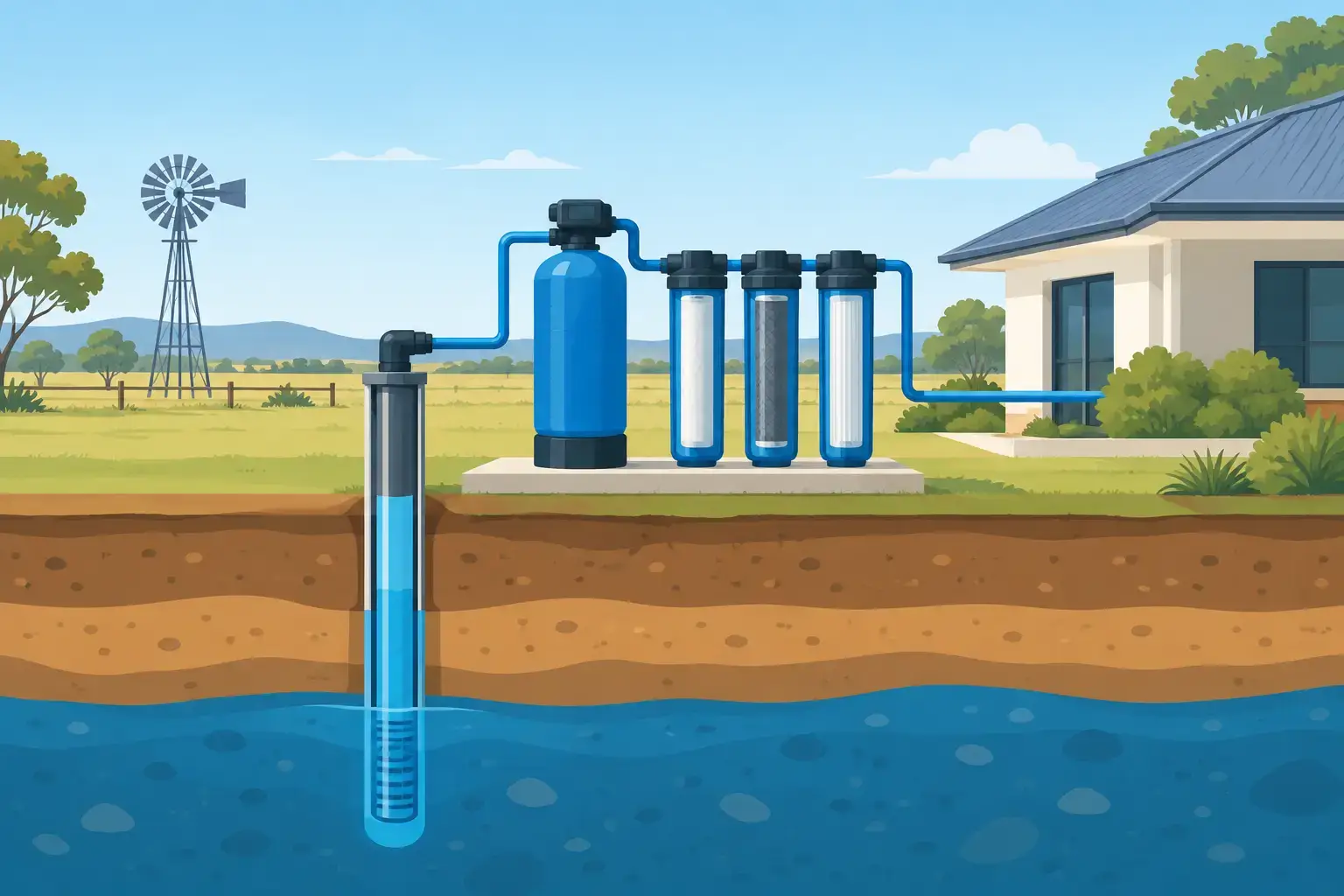
The ideal arrangement depends on the test results, but a common residential sequence begins with a coarse sediment pre-filter to protect equipment. This may be followed by an iron or manganese removal filter, a finer polishing filter and UV sterilisation for water intended for drinking and household use.
Where hardness is the concern, a softener may sit after sediment and iron treatment. Where drinking water has high salinity or particular dissolved contaminants, a reverse osmosis unit can be installed at the kitchen sink after appropriate pre-treatment. This approach keeps whole-house flow strong while treating drinking water to a higher standard where it matters most.
Storage is also part of the solution. A clean, covered tank can buffer bore supply, allow treatment equipment to operate more consistently and provide reserve water during pump servicing or power interruptions. If bore water is being stored, tank hygiene and the condition of lids, screens and pipework matter just as much as the filter selection.
Size the System for Flow, Not Just Filter Microns
A filter that works on paper can be frustrating in practice if it restricts water flow. Consider how many taps, showers, toilets, stock troughs or irrigation zones may operate at once. A family home with two bathrooms needs a different flow rate from a cottage, dairy washdown area or small commercial site.
Check the pump’s duty, pipe size, pressure requirements and the pressure drop across each filter stage. Fine cartridges provide better particle capture, but they can reduce flow as they load up. Backwashing filters need sufficient water volume and pressure to clean their media properly. Undersized equipment can cause low pressure, short filter life and inconsistent treatment.
For rural and acreage properties, it is also sensible to separate potable and non-potable water lines where practical. Treated water can supply the house, while less-treated bore water may be suitable for irrigation, washdown or stock use if it is appropriate for those purposes. This can reduce treatment costs and make maintenance more manageable.
Maintenance Is Part of Water Quality
No bore water filter is maintenance-free. Cartridges need replacement, washable pre-filters need flushing, backwashing media filters need correct programming, and UV lamps and sleeves need servicing. Keep a simple record of service dates, pressure changes and water-quality issues such as new staining or odour.
A sudden loss of pressure often means a filter is blocked, but it can also point to pump, pressure-switch or plumbing issues. New discolouration may indicate an exhausted media bed, changed bore conditions or sediment entering after a storm. Retesting the water when conditions change helps distinguish a maintenance task from a system that now needs adjustment.
North Coast Water Tanks can help property owners match tanks, pumps, filtration and UV equipment to the realities of their site. The goal is not to add unnecessary stages, but to build a dependable system with quality components, practical service intervals and capacity for the way you use water.
A good bore water system begins with evidence, not assumptions. Test the supply, design treatment around the result, and allow room for routine servicing so clean, usable water remains one less job to worry about.